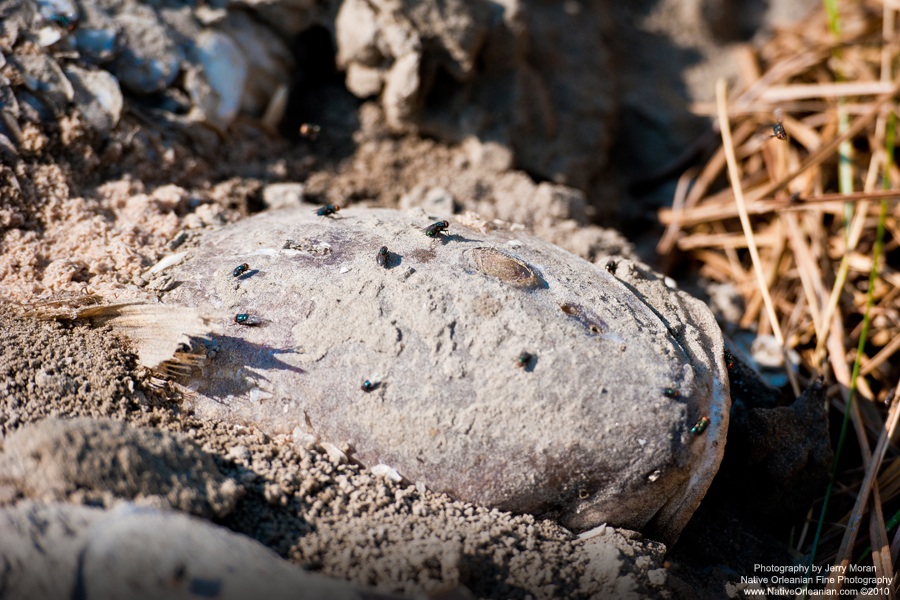
Whatever Happened to the Gulf Oil Spill?
Back in May I met the CEO of a major environmental group for coffee in Washington. This was a few weeks after BP’s Deepwater Horizon rig had exploded but before the oil had really made landfall along the coast. The country’s attention was focused on the spill, and anything seemed possible. No one knew exactly how much oil was leaking every day — the government said perhaps 5,000 barrels a day, but independent academics reported it could be far more. Models showed that currents might be able to take the oil slick east all the way around Florida, striking the Keys, Miami Beach and eventually much of the East Coast. And fishermen in Louisiana and hotels in Alabama and Mississippi were already panicking over a lost summer.
The environmental CEO was obviously worried about the impact of the spill on the people and the ecology of the Gulf Coast, and he was angry about the nonexistent government regulation that had failed to stop the accident. But he also saw an opportunity. The oil spill would show Americans — in sticky, visceral detail — the true costs of their energy policy. Just as earlier disasters like the 1969 Santa Barbara spill had mobilized the environmental movement, the Gulf spill would motivate support for new legislation to curb carbon emissions. “When TV cameras show oil hitting Miami by the end of the summer, it’s going to change a lot of minds,” the CEO said.
Fast forward to six months later. The carbon cap-and-trade bill, just being introduced to the Senate back in May, has died without a vote. The Presidential moratorium on new deepwater drilling was lifted early this fall, before the official government report on the causes of the spill even came out. Congress never managed to pass legislation that would have overhauled drilling safety, nor did it make any new laws that would have helped move the country off fossil fuels. After the midterm elections, which swept Republicans into the House and weakened Democrats’ hold over the Senate, the chance of tough climate and energy legislation seems remote. And the oil spill itself — so white-hot during much of the summer — seems to have vanished entirely from the media’s attention.
What happened? Some lucky breaks helped — or hurt, depending on your perspective. Even though more oil was spilled by the Deepwater Horizon than any other event in U.S. history — 4.9 million barrels, by the government’s most recent estimate — it happened more than 40 miles into the Gulf, meaning that much of the oil had evaporated or been digested by bacteria by the time the first patches reached the marshes of southern Louisiana. A spill closer to shore might have left the wetlands drenched, like the shores of Prince William Sound after the Exxon Valdez spill. The Gulf Coast was also lucky that it was never hit by a major hurricane this season — a storm at the wrong place and the wrong time could have pushed waves of oil up onto the land.
The result was that, while scientists are hesitant to make any conclusions yet, the spill didn’t destroy the vulnerable Louisiana wetlands to the degree that environmentalists feared. (My TIME colleague Michael Grunwald deserves credit for making that argument well before anyone else.) The impact of the spill on the Gulf itself, on the aquatic ecosystem and the fish (and fishermen) that depend on it, is much less clear. Some scientists have said there is a great deal of oil still suspended in the depths of the Gulf, or even on the seafloor, but a Coast Guard report released on Dec. 17 found there wasn’t enough left to bother recovering. We may not be able to assess the impact on fisheries for years — certain species in Prince William Sound seemed healthy for a couple of years after the Valdez spill, only to eventually collapse — but the early reports are mixed. It’s even possible that the effective moratorium on most fishing in the Gulf as a result of the spill may have even given some widely hunted species a chance to bounce back.
But while the economic impact on hundreds of thousands of Gulf Coast residents has been immense, the spill itself began to recede from national attention well before its true scope was known. And the damage — or lack of it — doesn’t explain why the spill had so little impact on the politics of energy and climate. That’s explained by, well, politics. Unlike 1969 or even 1989, the environment isn’t the bipartisan issue it once was. Like so much else it’s now split down the aisle, with most Democrats favoring action and nearly all Republicans steadfastly opposing it. Any idea that the oil spill would have somehow changed that probably died the day Republican Representative Joe Barton apologized to then-BP CEO Tony Hayward for the White House’s supposed “shakedown” in securing a $20 billion fund from the company to pay for the spill damages.
The spill wasn’t horrible enough to jolt the country into action on energy and climate, but I’m not sure anything would have been enough — not with the current gridlocked political climate, and not with the headlock oil and gas has over certain parts of the country. When I traveled down to Louisiana to report on the spill, I was shock to find that most locals, as angry as they were over the disaster itself, were angrier with President Obama over the drilling moratorium. But it shouldn’t have come as a surprise: a report from the Federal Reserve last February found that oil and gas accounted for 6.5% of Louisiana’s revenue, more than five times the national average. To oppose the oil industry in Louisiana is a political death sentence — which is why Democratic Senator Mary Landrieu and Republican Senator David Vitter were united in their insistence on lifting the moratorium as soon as possible. A 4.9 million barrel oil spill didn’t change those calculations.
That’s left environmental groups glum this holiday season. If the Gulf spill won’t alter our relationship with oil, what will? Perhaps only one thing: cost. The only recent time we seemed close as a country to changing the way we use energy was in 2008, when gas prices skyrocketed past $4 a gallon. Those days may be coming back — gas is nearly $3 a gallon, and oil is creeping towards $100 a barrel as the global economy gets up off the floor. It’s almost inevitable that a true recovery will bring back high energy prices, and that might finally be enough to force Democrats and Republicans to enact legislation that can actually make a difference. If we’ve learned one thing about the American public, it’s that an oil spill may be a disaster, but expensive gas is considered a real catastrophe.
Oil cleanup slow, careful in Bon Secour (VIDEO)
Oil cleanup workers at the Bon Secour National Wildlife Refuge have endured wilting heat, and now they’re toiling in the windy cold.
The 140 crew members for Task Force 1 — covering a territory from Mobile Street to the tip of the Fort Morgan peninsula in south Baldwin County — are removing between 4,000 and 8,000 pounds of oil waste per day, seven days a week.
That estimate comes from O’Brien’s Response Management supervisor Phil Perry, a retired Coast Guard officer who led visitors on a site tour. ORM is one of many contractors doing cleanup work for BP PLC.
Another task force on the refuge is making similar progress.
The cleanup work takes a more delicate pace within the Bon Secour refuge, which encompasses about 7,000 acres including 3.5 miles of beaches.
“This is the last remaining intact dune ecosystem in Alabama,” said refuge Manager Jereme Phillips, a U.S. Fish and Wildlife Service employee.
Phillips has been based at the refuge for eight years, a hectic time that’s included the oil spill and two major hurricanes.
“Nowhere else can you find pristine beaches that transition to frontal dunes, tertiary dunes and then a maritime forest behind that,” Phillips said. “It’s still natural and unfragmented. There are portions of this elsewhere, but you’d find a highway in the middle of it.”
The refuge also contains fresh and saltwater marshes.
Of the main types of beach cleaning that BP has employed — the Sand Shark tractors, power screeners and hand-cleaning — the latter is seen most on the Bon Secour refuge.
Even getting to the work sites is different here, Phillips said.
Workers in utility vehicles keep within a tightly marked pathway, their movements and actions monitored by resource advisers from the Fish and Wildlife agency.
Workers are primarily looking for tar mats. Those thin layers of oil, buried by blowing sand, can be buried 2 feet deep or more. Workers follow the vein of oil, removing it as precisely as possible.
Tarballs on top of the sand can be picked up with the same kind of hand nets used to clean pools.
Perry said that the chilly weather and passage of time since the spill have made the oil drier and thus easier to collect.
Workers continue to wear hazmat gloves and booties, but now also sport additional headgear and layers to stay warm.
“When the oil was gooier, the booties were important because we didn’t want them tracking oil from the work site, but the oil is so dry now it won’t stick,” Perry said.
Phillips said he’s been pleased with the working relationship between contractors and those charged with protecting wildlife habitat, whether it be sea turtles, shore-nesting birds or other creatures.
“It’s very much a joint effort and it’s moving forward but it’s going to be a long road. We won’t be completely finished with cleanup operations anytime soon,” he said.
BP spokesman Justin Saia said, “We’ve said all along that we expect the beaches to be clean by spring break tourism season, that’s been our goal and commitment all along, and from what I hear things are going well toward reaching that goal.”
See video here: http://blog.al.com/live/2010/12/oil_cleanup_slow_careful_in_bo.html
Gulf oil spill: Deep water cleanup still needed?
The debate over how much oil remains in the Gulf and where it is continues as research groups, environmental organizations, and government scientists conduct separate missions.
Chicago – A report released Thursday specifies that there is not enough oil remaining near the Macondo wellhead to warrant continued cleanup operations in the deepwater region of the Gulf of Mexico. As a result, response teams dedicated to cleanup efforts are being redirected to focus solely on oil mats located in shallow, sub-tidal areas offshore.
National Incident Commander Rear Adm. Paul Zukunft said the report prepared by his team is based on a six-month collection effort of 17,000 water and sediment samples that started in May, one month after the explosion of the Deepwater Horizon oilrig that released 205 million gallons (4.9 million barrels) of oil into the Gulf.
The report found no oil in sediments collected beyond the shoreline. It also finds that less than one percent of samples taken since early August exceeded the Environmental Protection Agency’s benchmarks for polycyclic aromatic hydrocarbons, which are carcinogenic, and that none of the water samples exceeding these benchmarks originated from the damaged well.
The news contradicts the work of Samantha Joye, a University of Georgia marine biologist whose team continues to report findings of thick oil layers deeply embedded on the ocean floor as far as 70 miles from the Macondo well site.
Joye was a member of a team of scientists reporting in mid-August that 80 percent of the oil remained in the Gulf in a highly toxic state and that, due to the high volume of dispersants used near the Macondo site, it is impossible to estimate how long it will take for the oil to fully degrade.
“It’s going to take, I would suspect, years for the system to recover … and it’s going to take more time for certain components of the system to recover,” she told National Public Radio last week.
The debate over how much oil remains in the Gulf and where it is continues as independent research groups, environmental organizations, and government scientists conduct separate missions to test water and sediment for evidence of the volume, concentration, and movement of the oil.
Reaching consensus does not appear to be on the horizon, although one may be needed: This past week the US Department of Justice filed a civil lawsuit against BP, the well owner, as well other operators involved in the explosion. The result could subject the companies to billions of dollars in penalties and damage claims.
The Unified Command report arrives with news that Rear Adm. Zukunft will be transitioning back to Coast Guard headquarters in Washington, D.C. and transferring cleanup operations to the regional Coast Guard authority led by Capt. Lincoln Stroh. Zukunft assumed federal authority over the recovery effort in September when he took over for Retired Coast Guard Adm. Thad Allen.
Over 360 vessels and a workforce of 6,400 remain in the Gulf at work on the recovery effort.
Playing the oil spill claims game
MOBILE, Ala. – As the oil spill claims operation enters its final stage, many business owners along the Gulf coast are preparing to play a game of Deal or No Deal, with billions of dollars and perhaps the survival of hundreds of ventures at stake.
For most larger businesses, the claims process will come down to a choice between taking a one-time, lump sum payment or continuing to take smaller, quarterly checks, giving owners and managers more time to judge the future impact of the spill.
Both claims require financial documentation. Either choice has pros and cons.
A business that accepts a lump sum to cover projected losses — and signs the required waiver promising not to sue or return to the claims process — won’t be able to get additional compensation if the oil continues to harm the coastal ecosystem or economy.
If the economy returns to normal faster than expected, the lump sum becomes a windfall that won’t be seen by businesses that opted for interim payments. But interim payments provide a hedge if future impacts are worse than anticipated.
Businesses that accept the lump sum also rid themselves of dealings with Ken Feinberg’s Gulf Coast Claims Facility, no small benefit for many who have spent dozens of hours since the summer collecting financial documents and talking to adjusters.
Sheila Hodges, owner of Meyer Real Estate, one of the coast’s largest condominium rental firms, said the uncertainty is too large to take a lump sum payment.
“When the majority of your income comes during a small time in the middle of the year, you can’t have a dialogue without going through at least one summer,” she said.
Others said that if Feinberg can make it worth their while, they’ll be happy to take one final check and move on.
“If it’s worth enough for me to survive for a while, I’ll take the final offer,” said David Wright, who owns a construction firm that lost home-building contracts after the spill hit. “I don’t want to drag this out any longer than they do.”
Feinberg is also offering quick, no-proof-necessary payments of $5,000 for individuals and $25,000 for businesses to anyone who was approved for an emergency claim. Those payments are geared more toward individual workers or small business, Feinberg has said.
Feinberg said he hopes the quick-pay option will clear a lot of claimants from a system that got some 466,000 requests for money and has paid 168,000 claims.
For those who eschew the quick-pay option, Feinberg’s operation will review financial documentation on losses to date and consult with experts to try and gauge the length and severity of spill impacts.
Adjusters will tabulate both a final settlement offer and an interim check amount, then let people choose, Feinberg said.
“If you’re satisfied, we will cut the check,” he said. “If you’re not satisfied, here’s the interim payment, come back in three months if you want.”
Feinberg told the Press-Register that he knows he has to pay a premium to get claimants to bear the risk that comes with accepting a lump sum and signing the lawsuit waiver.
“They’re going to say, ‘If you want me to sign a piece of paper that says I won’t be back, what are you offering me?’ That’s a fair question,” he said. “Generosity is going to have to be a major part of this.”
For Some Investigators, BP Oil Spill Is Just Beginning (AUDIO)
It’s been nearly eight months since the Deepwater Horizon tragedy killed 11 workers and spilled millions of gallons of oil in the Gulf of Mexico. Since April, federal agencies have launched a series of separate investigations and this week the U.S. Chemical Safety Board held its first round of public hearings. Host Scott Simon talks with NPR’s Jeff Brady about the continuing investigations into the causes of the BP oil spill.
SCOTT SIMON, host:
It’s been nearly eight months since the Deepwater Horizon tragedy killed 11 workers and spilled millions of gallons of oil in the Gulf of Mexico. Since April, federal agencies have launched a series of separate investigations. This week, the U.S. Chemical Safety Board held its first round of public hearings.
NPR’s Jeff Brady is here to help us sort through the various panels and their findings so far. And Jeff, thanks for being with us.
JEFF BRADY: My pleasure.
SIMON: How many investigations are there again?
BRADY: If you count just sort of those big government investigations, then there are five of them underway right now. They’re all separate from each other but they’re pretty much examining the same question of what happened and how can it prevented in the future.
I think most of us have heard of the highest profile investigation – that’s the president’s spill commission. And their report is due out next month. There is a joint investigation by the Coast Guard and the Bureau of Ocean Energy Management. They’re going to have a report right around the one-year anniversary of the Deepwater Horizon accident. And the National Academy of Engineering, they put out an interim report here a couple of months back that talked about some of the signs that the crew on the Deepwater Horizon missed. They’re going to have a final report out in June.
And then you mentioned the Chemical Safety Board – very independent. They don’t actually have a deadline, so we don’t know when that report will come out. And then the Department of Justice, of course, is investigating to determine any sort of legal action that that agency might take.
SIMON: There are so many investigations because you have various agencies that feel they have to essentially get on the boards with their own analysis – or do the multiplicity of investigations bring out more information and result in changes?
BRADY: Each time one of these agencies saw what the others were doing and they thought, well, I can bring something more to this, they launched their own investigation. So now we’re left with five different investigations.
I think the interesting question right now is – when we get into next summer and a lot of these folks have released their final reports – are these investigations going to be reaching similar conclusions? Because if they’re not, then we’re going to have a whole new set of questions to answer here.
SIMON: Let me follow up on DOJ, because they filed a civil lawsuit against BP and some of the other companies involved this week. What about the possibility of criminal charges?
BRADY: You know, I wouldn’t be surprised if there were criminal charges filed. The civil lawsuit that you just mentioned – it’s based on the government’s belief that BP and the rig operator, Transocean, and the other companies involved took shortcuts on safety and that led to the accident. In the filing here this last week, they said that the companies didn’t use proper equipment in drilling that exploratory well, the crew didn’t pay enough attention to the warning signs that were on the rig and down below underwater.
And Attorney General Holder specifically said in announcing that civil suit that this was only the first step that his department was taking, that the criminal investigation is ongoing. And of course this administration has sent pretty strong messages all along that they’re going to hold these companies accountable.
SIMON: And of course you mentioned the president’s oil spill commission report coming out in a few weeks. But then they’ve already kind of released a few findings, haven’t they?
BRADY: In October there was a staff report specifically critical of Halliburton’s cementing job. This past week there was another staff report talking about these sand barriers that the local politicians wanted built to sort of stop that oil as it would come ashore to Louisiana. And the commission staff put out a working paper saying that those barriers were pretty much ineffective.
And Governor Jindal actually called the assessment a partisan assessment and that really gets to another issue with this president’s spill commission, that folks within the oil industry really feel like they’re not represented on that panel, that it’s heavily weighted in favor of environmentalists.
SIMON: And has the tragedy that began the spill at the Deepwater Horizon brought about a substantial change in safety standards?
BRADY: The regulators have pretty much rewritten their rules. They’ve completely overhauled their program. Huge changes have taken place over the last eight months. That’s really confused the industry. I think the real issue that we have here is that this is an industry that’s used to having a pretty close relationship with its regulators. The previous administration, a lot of those folks came out of the oil industry.
And while these folks feel like they’re being specifically targeted, I think it’s really more of an issue of them becoming accustomed to having a thorough and vigorous regulator once again.
SIMON: NPR’s Jeff Brady, thanks so much.
BRADY: Thank you.
Listen to audio here: http://www.npr.org/2010/12/18/132162099/For-Some-Investigators-BP-Oil-Spill-Is-Just-Beginning?ft=1&f=1007
Size Protects Government Contractors That Stray
WASHINGTON — Weeks into the largest oil spill in American history, government officials met in Washington to discuss ways to compel BP, which leased the drilling rig, to move faster in stopping the spill.
One proposal called for suspending the company from getting government work under a federal law aimed at protecting taxpayers against unscrupulous contractors.
But there was a snag. BP, the regulators knew from experience, might be too big to ban. They recalled that last year, before the spill in the Gulf of Mexico, officials at the Environmental Protection Agency wanted to stop BP from getting government contracts until it addressed various environmental and safety violations. Then, according to a lawyer involved in the debarment process at the agency, the Pentagon objected: BP was its biggest supplier of fuel.
As the case of BP illustrates, the largest companies often escape the stiffest penalties because government agencies are too dependent on them. And even when there are suspensions or debarments they usually affect individuals or a business unit within the company, not the whole company.
The top 100 government contractors have paid more than $19 billion in cases of fraud, bribery, falsifying records and other violations over the past 15 years, but only four of them have been suspended from government contracting, and none have been debarred, according to a database from the Project on Government Oversight, a group based in Washington. The database is based on the contractor rankings for the 2009 fiscal year.
The issue of how to deal with these big companies has gained currency in recent months because of the BP case and allegations that Iraqi officials were bribed by Blackwater Worldwide, now called Xe Services, in violation of the Foreign Corrupt Practices Act. In the case of Blackwater, State Department officials pledged to pull its contracts, only to find that no other security companies were big enough to do the work.
While small companies are often debarred, the biggest ones, like BP, have become the equivalent of “too big to fail,” Senator Russ Feingold, Democrat of Wisconsin, said at a Congressional hearing this year.
“We need to hold government contractors to a high standard,” Mr. Feingold said, “and I do not think that large corporations should be given a free pass for behavior that would typically result in the debarment of a smaller corporation.”
Some government officials concede there are problems. During a recent conference, inspectors general from the Departments of Transportation and Homeland Security and the General Services Administration said the system was plagued by inconsistent standards, a reluctance to act in many cases, and other issues.
Numerous audits by the Government Accountability Office and federal agencies have pointed to shortcomings. One last year by the inspector general of the Agency for International Development found that the agency has not used contractor suspension and debarment to adequately protect the public interest.
Only three agencies in the federal government have full-time debarment officials, the E.P.A., the Air Force and the Navy. The rest have part-time officials who are typically part of the procurement office, creating a potential conflict because these officials are also trying to arrange contracts for their agencies.
Representative Luis V. Gutierrez, Democrat of Illinois, has pushed through an amendment to the military authorization bill requiring the secretary of defense to review whether BP is a “responsible” contractor, with a “satisfactory record of integrity and business ethics.” If not, the legislation would require Defense Secretary Robert M. Gates to bar the oil giant from military contracts, said Mr. Gutierrez’s spokesman, Douglas Rivlin.
Last month, the House of Representatives passed a debarment bill, introduced by Peter Welch, Democrat of Vermont, that would ban contractors guilty of violating the Foreign Corrupt Practices Act from government contracts. It was aimed at Xe Services, which has not been charged with or convicted of a crime, but it would also affect large government contractors like BAE Systems, Daimler AG, and Innospec Inc., which all pleaded guilty this year to making illegal payments to foreign officials.
Both measures passed with bipartisan support.
Alan Chvotkin, executive vice president and counsel of the Professional Services Council, a Washington trade group that represents large contractors, said he thought the current system worked well.
Large corporations, Mr. Chvotkin said, are often better able to identify and correct misconduct, and that may account for the low rate of suspensions and debarments for the largest contractors.
At small companies, Mr. Chvotkin said, the person responsible for the misconduct might be the company leader who is also critical to making or providing what the government needs. “If you remove or isolate him, you isolate the expertise, and the company can’t really provide a service to the government,” he said.
He added that “since there are more small companies with government contracts than larger ones, it makes sense that they would be represented more in the database.”
Government debarment officials say they aggressively pursue companies regardless of size, citing the suspension of International Business Machines in 2008 after an E.P.A. employee provided proprietary information to I.B.M. employees that was used to try to win a government contract, Boeing in 2004 for illegally obtaining proprietary information from a competitor, and more recently L-3 Communications after it admitted to monitoring e-mails of its workers, workers for other contractors and United States government employees.
Two units of BP have also been banned from government contracts because of environmental and safety violations that resulted in the death of several workers. More recently, the government suspended GTSI, a big contractor, but reinstated it after the chief executive and the general counsel resigned. It recently won a share of a $30 billion contract from the F.B.I.
“I have always been empowered to do the right thing, regardless of the impact that a debarment would have on the ability to obtain specific goods or services,” said Steven Shaw, a debarment official with the Air Force, who was responsible for L-3’s suspension.
Debarment officials say agencies can be tough in ways other than suspension and debarment, including agreements in which companies agree to corrective measures with oversight by the agencies.
The government has suspended some big companies, but critics note that these cases usually involve individual units and not the entire company, unlike cases involving smaller businesses.
In the case of the Boeing suspension six years ago, they point out that it applied to two business units and that the government granted them a waiver and gave them contracts worth more than $50 million because of “compelling needs in the national interest,” according to the Air Force.
Scott Amey, general counsel of the Project on Government Oversight, said that although the Justice Department had gone after contractors for fraud and other crimes, its efforts had not been enough of a deterrent.
He noted that in May, the chairman of the House Committee on Oversight and Government Reform, Representative Edolphus Towns of New York, wrote to Attorney General Eric H. Holder Jr. expressing concerns that criminal and civil settlements between the Justice Department and federal contractors were preventing federal agencies from suspending or debarring poorly performing contractors.
In certain instances, Mr. Amey noted, contractors subject to civil and criminal settlements with the department continue to rack up violations.
Mr. Amey rejected the notion that the inclusion of so many small companies on the government’s list of banned companies was simply a matter of numbers. “When you look at the fact that the bulk of federal dollars going to contractors are going to large companies, that argument doesn’t hold up,” he said.
Seeking justice in the BP oil spill
People in Louisiana and the rest of the Gulf Coast have much at stake in the lawsuit the U.S. Justice Department filed last week against BP and some of its partners at the ill-fated Macondo well – and not just because the case may likely settle how much the companies owe to repair the direct effects of the spill on our environment.
A much broader issue is whether BP and the other firms will be held accountable for the full extent of the spill and made to pay appropriate fines that can help pay for the long-term restoration of Louisiana’s coast. That ought to be a national priority, and the Obama administration should endorse proposals to use most of the spill’s fines for that purpose.
The federal lawsuit seeks to hold BP and other companies liable without limitation under the Oil Pollution Act of 1990 for the spill’s cleanup costs and for the resulting environmental and economic damage.
The government is also suing under the Clean Water Act, which allows for civil fines of up to $1,000 per barrel of oil spilled or $4,300 per barrel if the companies are found guilty of “gross negligence or willful misconduct.” That means between $5 billion and $21 billion in potential civil penalties are at play in this important litigation.
BP said it will respond to the suit “in a timely manner and will continue to cooperate with all government investigations and inquiries.” The company also noted its pledge of $20 billion for a compensation fund.
But already BP is trying to limit its liability by challenging the government’s estimate of the spill – and that’s not surprising. BP sought to minimize the spill from the beginning, first saying that only 1,000 to 5,000 barrels were spilling daily. Government scientists a few weeks later estimated that 12,000 to 19,000 barrels were actually spewing into the Gulf. A Flow Rate Technical Group of government and independent scientists eventually tripled the worst-case estimate, and a consensus set the official estimate at 4.9 million barrels over the spill’s 86 days.
BP is now saying the true figure is 20 percent to 50 percent lower, arguing that the flow rate increased over time as the riser pipe and the inside of the blowout preventer were eroded. The flow rate task force, however, concluded that the amounts of oil released decreased over time as the well lost pressure.
BP’s new argument contradicts evidence from the government’s technical group and from other independent scientists. Let’s also not forget that, throughout the spill, BP insisted the company couldn’t accurately estimate the flow rate – using that argument to try to low-ball the amount of oil escaping.
BP’s motivation in disputing the spill’s estimate is obvious. If the Justice Department calculated the spill’s fines based on BP’s new estimate, the maximum ordinary fine would be lowered by $2.5 billion. If BP and its contractors are found grossly negligent, the fine would be reduced by $10 billion.
For BP, this is primarily an issue of dollars and cents – not of science.
But how that is settled will be crucial for our region, which is hoping that a portion of the fines will help pay for coastal restoration. The urgency of reversing decades of coastal erosion and restoring our wetlands can’t be overstated – the future of the region and much of the Gulf Coast hangs in the balance.
Louisiana’s wetlands produce a third of the nation’s seafood. Our coast also supplies much of the nation’s domestic energy and is home to the country’s largest port system. Wetlands also are vital to reduce storm surge and are metro New Orleans’ first line of defense against hurricanes.
During the spill, President Obama promised that the federal government would “do whatever it takes for as long as it takes” to address the crisis but also to help restore the Gulf’s environment and economy. That must include saving Louisiana’s coast, a massive and expensive task. Louisiana will finally begin receiving a significant share of oil and gas revenues to pay for coastal restoration, but not until 2017. But our state has less than a decade to reverse coastal loss before it’s too late, and we need the money to fix the coast now.
That’s why state officials from both parties have urged that most of the fines paid by BP and other firms be used for long-term coastal restoration. So has Navy Secretary Ray Mabus, whom President Obama appointed to craft a recovery strategy for our region after the spill. In making the case that “a significant amount” of the fines should be used to restore Louisiana and other affected areas, Secretary Mabus said, “the Gulf was the place where the spill happened, the Gulf took the risk, and the Gulf took the damage.”
He’s right.
That sets the government’s claims apart. Yet attorneys representing private plaintiffs suing BP have asked U.S. District Court Judge Carl Barbier in New Orleans to consolidate all lawsuits into a joint case. That could eventually force governments to share winnings obtained on behalf of the public with the private plaintiff attorneys – and Judge Barbier should reject the lawyers’ request.
In filing the suit last week, Attorney General Eric Holder referred to it as part of the government’s “work to ensure that the American taxpayers are not forced to bear the costs of restoring the Gulf area – and its economy.”
That should be the nation’s top interest in this lawsuit – and that’s also why this case will be crucial for the future of our region.
There’s a promise of quick payment, but no easy choice for coastal businessman
Like so many others along the Gulf, Chad Breland has a decision to make.
Breland is an independent distributor selling Bunny brand bread products to restaurants, grocers and convenience store operators in Gulf Shores.
His business, he believes, is directly tied to the tourist economy of the Gulf Coast.
“If this hotel weren’t in front of me, I could see the beach right now,” he said last week while making his rounds.
It took Breland a while, however, to convince officials with the Gulf Coast Claims Facility that the beach connection was valid enough to pay his oil spill claim.
Eventually, U.S. Sen. Jeff Sessions’ office got involved on his behalf, Breland said, and in October he received a check to cover some of his summer losses.
“It was fair for what I filed,” he said.
The payment also means that Breland is among the 168,000 individuals or businesses that could, with little additional effort, snag another payment from Ken Feinberg’s claims organization. Anyone who, like Breland, got at least one emergency payment can now opt for a quick-pay claim of $5,000 for individuals or $25,000 for businesses. To take the money, he must walk away from the claims process going forward and agree not to sue BP PLC or any other company involved in the well that spewed oil into the Gulf.
So how does he decide whether to stay in the claims process or take the quick money?
He talks to lawyers or people who know lawyers. He figures that going to court to recover money would take years.
He recalls what he lost during the summer spill. “I’m thinking, oh gosh, if I lost that again this year …” he said, then let the sentence trail off.
He evaluates business along the coast today – up for some of his customers, down for others. For him, generally, it is within about 5 percent of the norm for a December.
He listens to his gut, which tells him that tourists will come back to this part of the Gulf Coast.
And he talks to other people in the business community about the claims process – past and present.
In his estimation, some businesses got “railroaded” and some people collected more than they deserved.
“With anything like this, you get some abuse; we get it after every major hurricane,” he said. “I felt like all along that more local people should be involved in (the claims process). We’ve got Realtors and insurance people who would be good advisers. It’s all people who aren’t from here and have never been here.”
In the end, the $25,000, Breland said last week, isn’t likely to make him whole. But it is worth thinking about.
“If for nothing else, for peace of mind, it is in the ballpark,” he said. “To not have that aggravation over the next 18 months or two years …. it would almost be worth it to take it and say, ‘It’s over and done with.’”
Fishery edges forward as season winds down
HOUMA – Eight months after the Deepwater Horizon disaster claimed lives and livelihoods, one of south Louisiana’s most affected regions is toddling toward normalcy as the shrimp season winds down.
An estimated one-third of Louisiana’s shrimp fleet has actively fished since the deepwater well 50 miles off the coast of Venice began spewing oil into the Gulf of Mexico.
Shrimp harvesters and processors, as well as those involved with oysters, crabs and other seafood, are still picking up the pieces. But some reasons for hope are emerging, slowly and quietly.
Large numbers of white shrimp are appearing in some waters, which has caused the state’s Department of Wildlife and Fisheries to extend the 2010 season in some waters to Tuesday. There are plans to review whether other waters – which have a planned closure in March – will close on that date as well.
Marty Bourgeois, the biologist who runs the state’s shrimp program, said the closure of waters east of the Mississippi River is due to “tremendous numbers” of small white shrimp in the area.
“The object is to protect them and allow them to grow to a marketable size,” Bourgeois said. “We can all look into the spring and see the benefits of that.”
The large shrimp population is good news for a fishery whose participants didn’t know for months what effects the Deepwater Horizon spill would have on their crop.
Ernest Cheramie, a 49-year-old fisherman from Galliano, had good luck in recent weeks aboard his 49-foot double-rigger, the Jaia Marie.
“We were catching a good bit, enough to make some money,” he said. “But they didn’t hardly have any boats out there.”
He has been changing how he sells his catch, offering the biggest shrimp direct to consumers from the boat itself. The rest are sold to a dock.
The spill has had a marked effect on Louisiana shrimp production. In 2009 the state’s fishermen landed 96.7 million pounds, with a dockside value of more than $103.4 million between January and October. During the same period this year, nearly 53.2 million pounds were caught, valued at a little less than $85.6 million.
Some fishermen are taking steps to make their effort more efficient, with an eye toward next year’s spring season. James Blanchard of Houma is considering a new type of net on his boat, the Waymaker.
“I have heard a little bit of a different type of webbing that is supposed to create less drag through the water,” said Blanchard, who sits on the board of the eight-state Southern Shrimp Alliance representing Louisiana. “With the lighter webbing it would cut down on the fuel consumption.”
Blanchard said he and other fishermen who worked the oil spill cleanup communicated with each other on two-way radios while out on the water. “We were always in contact with a lot of guys we wouldn’t normally be in contact with,” Blanchard said. “We always had something to chatter about and discussing different things, gear types, other things. It was like we had a meeting of the minds.”
Changes are in store for how Louisiana markets its shrimp, with some of the most optimistic thinkers exploring how to set up export markets. Louisiana shrimp, some say, could sell well in Europe.
“We are still going forward with plans for the certification program and gear technology,” said Julie Falgout of Louisiana SeaGrant, the state’s cooperative extension for fisheries. “The fact that we are going forward and investing the time and the energy and the money in this tells me we have something to look forward to. My personal opinion is that they are not going to let us spend money for something we are not going forward with.”
The certification program, Falgout maintains, will have a positive effect on how much consumers will pay for shrimp that earn the grade. Shrimp given the certification are caught under conditions that maximize quality, such as shorter drags of the net and optimal chilling conditions, as well as handling to keep them from bruising.
“It’s a great product already and the program certifies that it has had the best kind of handling,” Falgout said, explaining that not all shrimp would qualify as “Louisiana Certified.” “Black Angus beef is an example of how this can work. Only 7 percent of all beef is Angus. But the Angus program helped bring up the price of beef. It’s saying that the certified shrimp is the best of the best and that is going to help everybody.”
Fishermen interviewed Thursday said they’re not certain about all that. But they do know that something needs to be done, because as the fishery recovers from the spill, pre-existing problems with low prices will return as an issue.
“You go to Burger King and it costs you $7 for a meal now,” Cheramie said. “You buy a pound of shrimp for $1 and it can make you a meal. But shrimp should never be $1 a pound.”
While prices stay low, Cheramie said, the cost of catching the shrimp continues to rise.
“Three weeks ago I took 100 gallons in fuel and three blocks of ice and it was $302,” he said.
Conditions on the water changed and the shrimp Cheramie had been catching were gone. Cheramie returned home.
“That’s a loss right there,” he said. “That’s what it was, a loss.”
Still, fishermen acknowledge they are keeping their eyes on the future rather than dwelling on losses of the past.
Tony Thibodeaux of Chauvin worked the oil spill for most of this year with the trawler Brandon James. But he’s readying for next year’s season. He is building a new metal building with an eye towards next year’s catches.
“Eventually I might want to retail some shrimp,” said Thibodeaux, who is also planning to have a freezer installed on his boat. “I’m talking about jumbo shrimp, a nice product presented the right way will sell.” Not all fishermen or processors are viewing next year with optimism, however.
With few fishermen on the water, prices are staying low, hovering at a dockside price of about $1 on average.
If most or all of Louisiana’s fishermen hit the water in May, when the season begins, there could be an overabundance of shrimp that could make prices fall farther.
4 Gulf Coast attorneys general urge oil spill victims to check with lawyers before settling
NEW ORLEANS – Attorneys general in four Gulf states are urging oil spill victims to consult lawyers before accepting final payments from a $20 billion compensation fund and agreeing not to sue BP.
They issued notices to claimants Thursday in Florida, Alabama, Louisiana and Mississippi. They warned residents that if they sign away their rights they can’t come back and get more money, even if they suffer new damage from oil from the BP rig explosion.
Claimants can now accept interim, final and quick final payments. Those opting for final or quick final must agree not to sue BP or any other responsible party.
Fund administrator Ken Feinberg says he appreciates the attorneys general looking out for their citizens and says he is doing that, too.
Claims Paid Quick – With a Catch (VIDEO)
Long lines outside claims offices throughout the gulf coast as Feinberg’s latest offer to those damaged by the BP oil spill takes effect.
FOLEY, Alabama – They lined up early in Foley and waited as long as two hours. “It wasn’t bad,” says Wes Martin. “They’re working with everybody pretty well doing what they can to get them out of here.”
Most are signing up for the one-time “quick pay” option announced earlier this week by Kenneth Feinberg.
“They’re given a payment of five thousand for personal, 25 thousand for business if you sign a release you won’t sue em,” says Lee Turner.
There are over 166 thousand individuals and business that are eligible. You have to already been approved or received payment on an emergency claim. “I’m trying to get what I can and get out before they bail on us. That’s the way i see it,” says Martin.
It wasn’t just the “quick pay” option that kept things busy at the claims offices across the gulf coast. Interim payments could be started today as well as paperwork for the final payment.
“People right now are desperate.” Orange Beach Mayor Tony Kennon was in contact with Feinberg’s office Friday. He says he has mixed feelings about the quick pay policy. “If it will get some of the folks off of the BP dole that don’t deserve to be there and get them out of the system that’s great. I don’t want people out of desperation to have go to it because they don’t know when they are going to get a check. I’m very concerned about that.”
Folks in line today, didn’t seem too concerned. “I think we were treated very fairly so, I was very pleased,” says Turner.
Folks applying for the quick pay option were told they would receive a check in two weeks.
See video here: http://www.wkrg.com/gulf_oil_spill/article/claims-paid-quick-with-a-catch/1203361/Dec-17-2010_6-33-pm/
Not enough oil left in offshore, deepwater Gulf to warrant additional cleanup, admiral says
There’s just not enough recoverable oil from the BP Deepwater Horizon blowout left in most offshore and deepwater areas to warrant additional cleanup operations, National Incident Commander Rear Adm. Paul Zukunft announced Friday.
Cleanup operations remain under way along shorelines and in wetland areas in Louisiana, Mississippi, Alabama and Florida, he said, where officials also will focus on oil mats – weathered oil mixed with sediment – found in shallow water just off beach areas. More than 6,400 workers and 360 vessels are still working on the oil spill response.
Zukunft’s decision was accompanied by an announcement that the federal-BP oil spill response organization is transitioning into a long-term response role, with Zukunft returning to Coast Guard headquarters in Washington as assistant commandant for marine safety, security and stewardship.
Capt. Lincoln Stroh will become federal on-scene coordinator, overseeing the continued cleanup operations of the Gulf Coast Incident Management Team, which now becomes part of the Coast Guard’s 8th District headquartered in New Orleans.
The decision against further cleanup operations at sea is based on a report from Zukunft’s Operational Scientific Advisory Team that found no liquid quantities of oil from the Macondo well blowout in sediments beyond the shoreline of the Gulf of Mexico. None of the 17,000 water and sediment samples reviewed in the report exceeded EPA human health benchmarks for toxic chemicals or dispersants.
Less than 1 percent of water samples and only about 1 percent of sediment samples exceeded EPA’s aquatic life benchmarks for polycyclic aromatic hydrocarbons, a cancer-causing substance used as a standard by the cleanup effort, according to the report, and analyses of individual samples found that none of the water samples that exceeded EPA standards were from BP’s Macondo well.
Traces of oil mixed with drilling muds were also found in deepwater sediments near the Macondo drilling site.
The samples reviewed for the study, however, do not include a larger set of samples being collected by federal, state and industry officials as part of the separate Natural Resource Damage Assessment effort, which is aimed at determining the effects of the spill on fisheries, wildlife and humans.
The report concluded that there was still a gap in sampling in near-shore areas evidenced by the continuing discovery of tar mats, and said a group of researchers is now targeting that problem.
Scientists also are awaiting the results of more complex toxicity studies of water and sediment samples that will be the subject of an addendum to the report in early 2011, Zukunft said in a letter accompanying the report.
Zukunft said the report was limited in scope to addressing response actions, “and does not draw conclusions about the long-term environmental impacts of the spilled oil.”
“We’re not saying there’s no evidence of oil,” said Charlie Henry, NOAA science technical support coordinator for the oil spill. “NOAA is still working hard with the Food and Drug Administration on monitoring seafood safety. But we’ve reached the point where there’s nothing left that can be done to recover oil in those areas.”
But Mike Utsler, BP’s Unified Area Commander, said the report’s results are “consistent with our observations that the beaches are safe, the water is safe, and the seafood is safe.”
“BP still has work to do to finish cleaning up the remaining oil that is near the shoreline, and we continue to work with the communities of the Gulf of Mexico to meet our commitments,” he said.
The report should not be considered as evidence the oil is not causing environmental harm, said Marco Kaltofen, a civil engineer and researcher at Worcester Polytechnical Institute who is assisting private attorneys who have filed suit against BP.
Or that the oil has truly disappeared.
“We’re still finding tar balls washing up, fresh oil still with fingerprints from the BP Macondo well,” he said, citing sampling he’s conducted all along the Gulf Coast. “We’re still finding fish and shellfish with measurable quantities of oil contamination coming from areas that still has oil that can be linked to BP.”
It’s also important that the cleanup decision not be confused with eventual restoration plans, either onshore or offshore, said Dennis Takahashi-Kelso, executive vice president of the Ocean Conservancy.
Zukunft’s decision, instead, follows the letter of the Oil Spill Act, which provides a framework for how the Coast Guard and other responders are to deal with initial cleanup decisions, he said.
Takahashi-Kelso said the results on which the admiral based his decision may also be incomplete, as some federal sampling may be under wraps in preparation for the Justice Department’s civil lawsuit against BP and other responsible parties, or for use in the damage assessment process.
Oyster industry stalls
Still rebuilding from a pummeling that Hurricane Ike inflicted two years ago, the Texas oyster industry is being slammed again this year — by even more complex challenges in the aftermath of the BP Deepwater Horizon disaster.
It’s not that the oysters themselves were tainted by the estimated 4.9 million barrels of oil that leaked into the Gulf of Mexico following the Deepwater Horizon explosion in April. But a combination of high prices this summer, weak oyster growth and an even weaker market for oysters — partially caused by consumer concerns over the safety of gulf seafood — has left Texas’ oyster producers with little work this year.
They probably still can find oysters to harvest, but many of the mollusks are smaller than normal. In addition, the state’s biggest oyster resource, Galveston Bay, still has thousands of acres of oyster reefs out of commission because of Hurricane Ike.
But the bigger problem is that producers are having a hard time finding buyers for what they do harvest.
“I’m not sure of the cause. All I know is oysters aren’t moving. People are not eating seafood,” said Buddy Treybig, a 10-year veteran of the oyster industry who owns Arnold’s Seafood Oyster House in Matagorda.
Treybig said he’s cut back to a skeleton crew and is working his processing plant only about half the days he normally would. He’s also limited his boats to harvesting 25 sacks of oysters a day, not even a third of what he’s allowed to take, because he does not want to get stuck with oysters that can’t sell.
Prices have slipped since the start of the oyster season in November. Customers could buy a pint of oysters for $9.50 and a 7-pound container for $55 at Hillman’s Seafood in San Leon this week, its owner said.
“It’s kind of scary,” Treybig said. “A lot of boat owners haven’t seen nothing like this.”
Lance Robinson, regional director of coastal fisheries for the Texas Parks & Wildlife Department in Dickinson, called it something of a “perfect storm” of problems for producers, with weak oyster production in Louisiana driving prices up in Texas while warmer weather leading up to the opening of the public oyster harvesting season last month kept Texas oysters from getting as plump as normal.
Demand for oysters also dropped, first because of the recession and then because the oil spill persuaded consumers to look for alternatives to gulf seafood, whether those products had been affected by oil or not, officials said.
Robinson said no oil has been detected in oysters here. Nevertheless, Texas’ oyster industry “basically shut down” shortly after the public season opened in November, Robinson said. But he said more boats may be scouring reefs for oysters this month in hopes that demand will pick up for the Christmas season.
What Texas brings in is important because it is typically the second-largest producer of oysters in the Gulf of Mexico, which Robinson said is the nation’s primary source for oysters.
Louisiana is normally the largest oyster producer, with up to half of the Eastern oysters harvested. Texas is typically responsible for 15 percent to 20 percent of the nation’s Eastern oyster harvest, said Robinson. Pacific and Olympia oysters also are harvested across the country, but not at the level of the Eastern variety.
Texas’ oysters reached a peak value of $19.2 million — the amount paid to boat operators — in 2007, but fell to $8.8 million in 2008, the year Hurricane Ike struck the Houston area, according to data provided by the state. Last year, the total climbed slightly to $9.4 million.
Oysters are harvested from about 2,300 acres of private oyster leases, all in Galveston Bay, and from more than 49,000 acres of public reefs, also concentrated in Galveston Bay but extending south to other bay systems and even the Lower Laguna Madre.
Lisa Halili, vice president of Prestige Oysters of San Leon, which has operations in both Texas and Louisiana, said the industry is crippled now primarily because of unfounded concerns about the safety of gulf seafood.
Upcoming marketing efforts could help dispel some of those fears.
Coast Guard contradicts independent scientists: Little seafloor oil from Gulf spill
NEW ORLEANS – The Coast Guard admiral overseeing cleanup of the BP oil spill says extensive sampling of the Gulf of Mexico seafloor has found oil in quantities too small to merit collection.
The Coast Guard’s findings — to be released in a report Friday — are in contrast to reports from independent scientists who say oil has extensively damaged the seafloor.
“We are not finding any recoverable amounts of oil,” Rear Adm. Paul Zukunft told The Associated Press. “We are finding traces of oil.”
He says the concentrations fall far short of harmful levels under federal pollution laws.
One site about a mile from the capped BP PLC well a mile under the Gulf has a higher concentration. Zukunft says no technology exists to collect it at that depth though it will be monitored.
Transocean ordered to turn over safety records to Gulf oil spill investigation panel
NEW ORLEANS — Transocean Ltd. must turn over a batch of safety records to a government panel probing the deadly rig explosion that spawned the massive Gulf oil spill, a federal judge ruled Friday.
Transocean, which owned the ill-fated Deepwater Horizon rig, had balked at providing some of the safety records for its other rigs in the Gulf of Mexico to the panel of Coast Guard and industry regulators.
Transocean argued that the records sought by the panel, including external audits of safety management systems, aren’t relevant to its investigation. But U.S. District Judge Carl Barbier ruled Friday that the panel is entitled to the documents.
A government attorney told Barbier that the records were needed to determine if the April 20 rig explosion resulted from a systemic problem with Transocean’s rigs.
“Is it something that could be across the board affecting other vessels in the Gulf,” asked Assistant U.S. Attorney Sharon Smith.
Transocean lawyer Richard Hymel said the government’s request is “the very definition of a fishing expedition.” The Coast Guard already has inspected Transocean’s other rigs in the aftermath of the explosion, Hymel added.
“They have to prove that the documents are relevant,” he said.
The panel of Coast Guard and Bureau of Ocean Energy Management Regulation and Enforcement investigators wrapped up its sixth round of hearings last week. At least one more round is expected before the panel files its report on what caused the disaster and what can be done to make sure it doesn’t happen again.
The rig blast killed 11 workers and left millions of gallons of oil spewing into the Gulf from a blown-out well on the sea floor. Barbier is presiding over more than 300 lawsuits stemming from the explosion and spill, including a suit the Justice Department filed earlier this week against well owner BP, Transocean and other companies.