RSS Feed for From Stuart Smith From Stuart Smith
Big Hit to Texas Oyster Industry Shows Government’s Big Credibility Problem
How big are the ripple effects from the BP spill? You can get an indication by looking at the Texas oyster industry, which was not hit directly by oil, but is feeling the effects of the BP-and-government credibility gusher.
The government squandered the people’s trust in this disaster, deciding at nearly every step to side with the BP – not just on large issues like flow estimates and the use of toxic dispersants and even declaring the “vast majority of oil gone” – but on smaller issues, too, like creating “safety zones” that barred reporters from cleanup areas.
So now the government sleeping in the bed its made. A case in point is that nobody believes them about seafood safety – and, consequently, the multi-billion dollar Gulf seafood industry is taking a HUGE hit. It turns out Honest Abe was right: You really can’t fool all the people all the time.
They feel this in Texas with an industry still recovering from Hurricane Ike. The Express-News out of San Antonio is reporting on the problem, and quotes a 10-year veteran of the oyster industry saying “… I’m not sure of the cause. All I know is oysters aren’t moving. People are not eating seafood.”
The paper also reports that “… Lisa Halili, vice president of Prestige Oysters of San Leon, which has operations in both Texas and Louisiana, said the industry is crippled now primarily because of unfounded concerns about the safety of gulf seafood.” She, of course, calls for an intense marketing campaign.
With all due respect to the marketing professionals, I think an aggressive campaign pushing seafood may very well backfire. Big, BP-style ads are not going to “make it right” with eating seafood. Unfortunately, the authoritative voice here – our government – has not proven itself worthy of our trust on spill issues. So with independent scientists once again contradicting the “official line,” the ads will add even more confusion to an already murky issue.
Over the course of this disaster, the government has pushed its credibility to the breaking point, essentially telling the American people that “sure, we were wrong about the flow rates, dispersant use, massive underwater plumes, oil settling on the ocean floor, the oil being gone, BUT we’re right about seafood safety.”
I have commercial fishing clients who would love to be out on the water today, doing what they do best. But my clients can’t resume fishing until they know its safe – they are not about to take their customers and their families into a risky situation. Let’s not forget that if people start getting sick from eating Gulf seafood, we can expect the industry to experience a protracted decline. Consumers won’t come back for a long time.
And there’s no way that BP and government officials can buy their way out of this problem with a marketing campaign.
The story out of San Antonio is here: http://www.mysanantonio.com/business/article/Oyster-producers-hurting-in-wake-of-oil-spill-907185.php
© Smith Stag, LLC 2010 – All Rights Reserved
Should U.S. Government Ban BP?
Many of us feel large corporations (like BP) get away with behavior that would land individuals or small-business owners in jail – or at least barred from government work. Now there’s some pretty strong evidence to indicate we are right about that.
The NYT is reporting that small companies are often banned from government work, a process called “debarment,” but not large ones.
Citing a database collected by the D.C.-based Project on Government Oversight, the Times reports that “… the top 100 government contractors have paid more than $19 billion in cases of fraud, bribery, falsifying records and other violations over the past 15 years, but only four of them have been suspended from government contracting, and none have been debarred.”
Even Blackwater, the infamous “security firm” that got into so much trouble in Iraq, was among the “too big to fail” crowd, forcing frustrated lawmakers to propose a law that firms violating the Foreign Corrupt Practices Act would be banned. When you’re proposing that kind of law, your confidence in the existing process has dropped to zero.
Perhaps even more interesting is that BP has, in the past, managed to push responsibility out into its many “working units.” We know these big companies create many layers of legal protection, and the NYT says that “…two units of BP have…been banned from government contracts because of environmental and safety violations that resulted in the death of several workers.”
The NYT story is here: http://www.nytimes.com/2010/12/18/us/politics/18contractor.html?_r=1
© Smith Stag, LLC 2010 – All Rights Reserved
State Officials Urge Spill Victims to Consult with Lawyers Before Accepting Final Payment from BP; Joint Letter Warns Victims to “Proceed with Caution”
Here’s a sign people have lost all faith in BP’s claims process: State officials sign a joint letter warning spill victims to “proceed with caution” and consult with attorneys before accepting a final payment from BP’s Gulf Coast Claims Facility (GCCF).
The attorneys general (AGs) from Florida, Alabama, Mississippi and Louisiana warn that final agreements with BP’s $20 billion compensation fund may bring a check, but they ban “any future remedy to any recurring or new problems that could come along.” The AGs offer an example: Should a hurricane wash more BP oil ashore next year, those who signed final settlements have no legal options.
Meanwhile, the GCCF has apparently missed another deadline on emergency claims. Kenneth Feinberg had said that all the claims would be cleared by Wednesday (Dec. 15), but the Press-Register’s Dan Muraugh reports that “thousands” of claims remained unprocessed Wednesday night.
That’s a huge deal as spill victims look at three payout options: (1) Take the new quick-cash final settlement if you were one of the lucky few who received an emergency payment; (2) file for a one-time final settlement; or (3) continue to file for quarterly payments. The first two require that you never sue BP and its Big Oil spill partners – while the quarterly payments do not.
But by making the claims process so slow, random and frustrating, the Claims Center has created a serious downside to what would otherwise seem a good option. Some people can handle that process, but many others will give up. One governor has already called the process “extortion” and now four AGs are urging caution and strongly recommending legal counsel.
What a sad day that it’s come to this for BP spill victims.
Read the Press-Register story here: http://blog.al.com/live/2010/12/ags_urge_caution_before_accept.html
© Smith Stag, LLC 2010 – All Rights Reserved
Vietnamese-American Fishermen Have Submitted 16,858 Claims…Only ONE Has Been Paid
We’ve noted before that claims policies set in Washington, D.C., are worlds away from the culture of the Gulf, and nowhere is that more clear than with the issue of Vietnamese-American fishing communities. There, the informal system of “barter” allowed families to trade seafood for a variety of services in what amounts to a neighborhood barter system.
This is not, of course, new to the BP claims debate. There’s even a name for it – an insulting, condescending name but a name nonetheless: the “Subsistence Use of Natural Resources claim” for anyone “who uses natural resources that have been injured, destroyed, or lost as a result of the Spill to obtain food, shelter, clothing, medicine, or other subsistence use,” according to the Gulf Coast Claims Facility.
And the Claims Facility also states that “an individual who uses fish or other wildlife for food but can no longer do so because of the Spill may file a Loss of Subsistence Use claim.”
Guess how many of those Subsistence claims have been paid? The Times-Picayune has that figure, and this whole story, in a report by Benjamin Alexander-Bloch: “Of the 16,858 claimants who have applied for loss of subsistence, only one so far has been accepted, according to Gulf Coast Claims Facility statistics. That claimant received $3,000. Amy Weiss, [GCCF] spokeswoman, said in an email message Wednesday afternoon: “Anyone who files a subsistence claim must provide documentation and evidence that he or she has been impacted and that he or she lives off the land.”
So, the program set up for people who legally barter but don’t have formal receipts has accepted ONE out of 16,858 claims. These are the same hard-working Americans who have trouble accessing assistance programs because of cultural and language barriers. It’s another look into the reality of what’s going on in Gulf communities.
This is yet another tragic chapter in an ongoing story of destruction and despair. If the Claims Facility doesn’t make accommodations soon for Vietnamese-American fishermen, we may very well see an entire community and culture disappear from the Gulf forever.
The Times-Picayune story is here: http://www.nola.com/news/gulf-oil-spill/index.ssf/2010/12/vietnamese-american_fishermen.html
© Smith Stag, LLC 2010 – All Rights Reserved
IS ANOTHER DISASTER INEVITABLE?: Offshore Drilling Infrastructure in the Gulf Is Crumbling…and Has Been for Years
Forget for a moment BP’s bogus promise to “make it right” on the Gulf, a new Wall Street Journal story documents just how far we have to go to “get it right” when it comes to offshore drilling.
Ben Casselman reports in-depth about our nation’s drilling rig infrastructure, and it’s not comforting: “The deadly explosion of the Deepwater Horizon drilling rig in April set off a fierce battle over deep-sea oil drilling aboard huge, state-of-the art vessels. But that debate has largely ignored what many experts say could be a bigger threat: The troubled state of offshore infrastructure that remains in place long after wells are drilled.”
And this, to add to your discomfort: “Roughly half of the Gulf’s more than 3,000 production platforms are 20 years old or more, and a third date back to the 1970s or earlier, long before the development of modern construction standards. More than half have been operating longer than their designers intended, according to federal regulators.”
What do government studies show about the connection between aging infrastructure and incidents of fires, accidents or potential disaster? Well, nothing – there apparently are none. That’s one of the things they teach lawyers: Don’t ask the question if you don’t want to hear the answer.
This amounts to a trillion-dollar issue, easily. And it would be one thing if the federal regulatory agencies could be trusted to keep an eye on things – but the BP spill teaches us that is not the case, even if they re-name major agencies. It’s an important story for the “next time” files.
© Smith Stag, LLC 2010 – All Rights Reserved
EXCLUSIVE TEST RESULTS: Red Snapper Sample from Off Pensacola Shows Dangerously High Levels of Contamination – Nearly 3,000 PPM of Total Petroleum Hydrocarbons
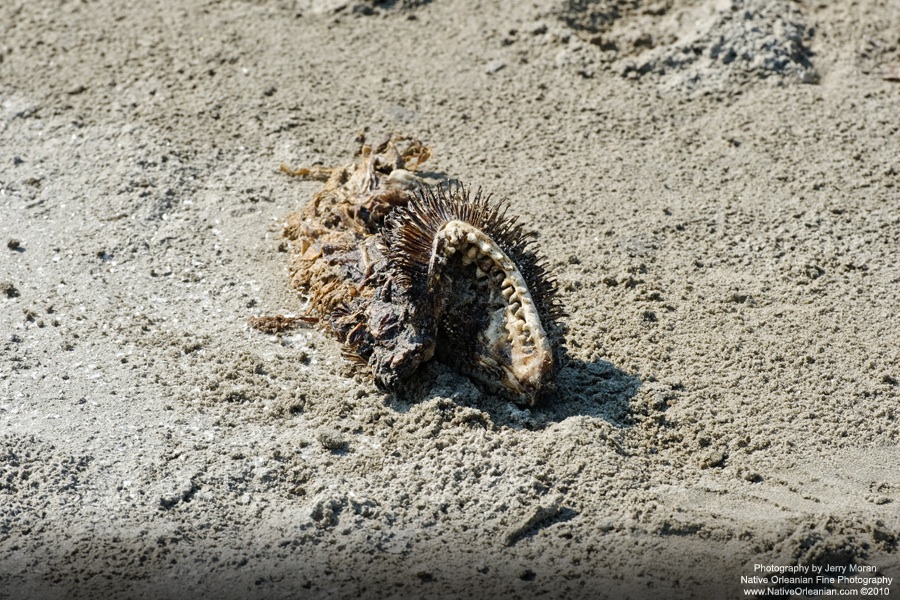
As the “seafood safety” debate intensifies, my research team continues to find dangerous levels of petroleum hydrocarbons in a variety of seafood samples – from jellyfish to royal red shrimp to oysters. The latest example (see below) is a highly contaminated 11-pound red snapper caught off the coast of Pensacola in September. The certified lab results show the viscera (i.e., internal organs) to be contaminated with nearly 3,000 PPM of total petroleum hydrocarbons – a dangerous level by any standard. Such high levels of toxicity in the internal organs indicate the snapper may have eaten contaminated food, like zoaplankton, which represents another troubling entry point into the food chain. These results clearly call into question the safety of the seafood coming out of the Gulf.
Sample description: Red Snapper – 11 lbs.
Sampled on: September 2010 by commercial fishing captain
Sample location: 30 + miles SW of Pensacola, FL
Testing by: ALS Laboratory of Edmonton, Alberta, Canada
The skin-on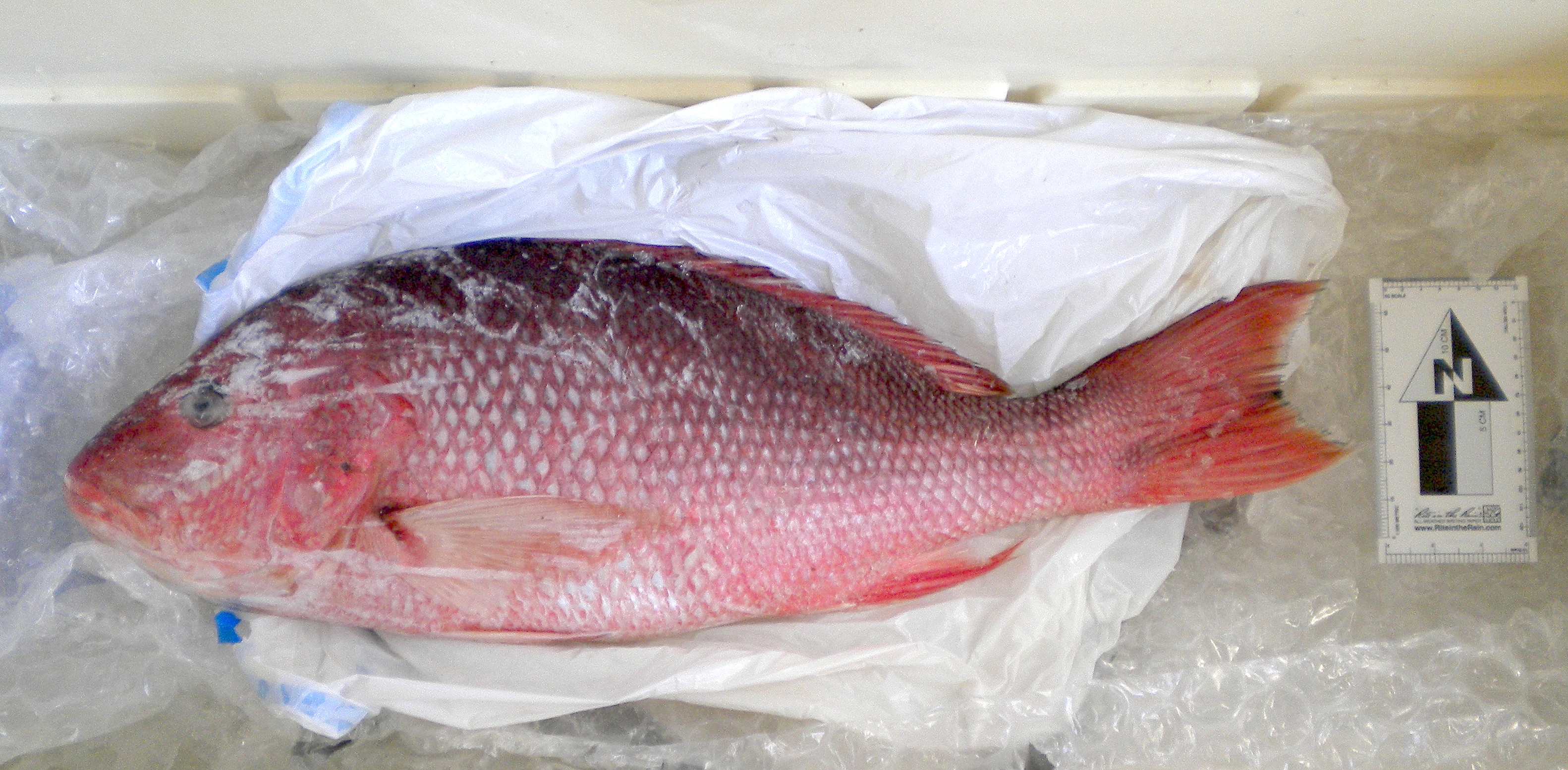 filet and viscera of the red snapper were tested separately. The filet was found to be contaminated with 87 mg/Kg, (parts per million), of total petroleum hydrocarbons, of which 53 mg/Kg were in the C17 to C35 range. The viscera were found to be contaminated with 2,970 mg/Kg, (parts per million), of total petroleum hydrocarbons, of which 1,784 mg/Kg were in the C17 to C35 range, and 263 ppm were in the C36 to C50 range. These are dangerously high contamination levels.
The petroleum hydrocarbons showed a characteristic series of major peaks at every third carbon number. This petroleum hydrocarbon pattern has shown up repeatedly among crabs, fish, and many oth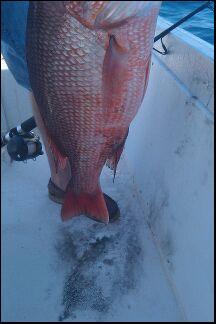 er contaminated organisms in the Gulf. This pattern may be indicative of the red snapper consuming contaminated prey, like zoaplankton, which are lower on the food chain. Other researchers have confirmed that zoaplankton – a common food for snappers – show substantial contamination from BP crude oil.
See certified lab results here: snapperdata
© Smith Stag, LLC 2010 – All Rights Reserved
Gulf Coast Claims Facility Entices Spill Victims to Sign Away Their Right to Sue BP
It was bad enough when submitting a claim to the BP claims process was like buying a lottery ticket – with a few big winners keeping others “in line” hoping they might be next to get paid despite increasingly long odds. Well, that random situation just got worse, and now it’s starting to resemble a bad game show.
The host of the show says, in effect: “Before we go into our final rounds, a surprise twist! Will you take the chance of determining your actual damages and hoping our secret process agrees, or will you take $5,000 and go home? Will you be gutsy enough to take your chances that the toxic soup you cleaned up for months won’t give you cancer?”
Unfortunately, the best name for this twisted game show is already taken: “You Bet Your Life.” We have to settle for what the Gulf Coast Claims Facility calls the “Quick Pay” option. It even sounds like a lottery game. The New York Times describes this latest legal maneuver: “Kenneth Feinberg, who administers the $20 billion fund formed by BP to compensate people for losses from the gulf oil spill, is offering what amounts to a signing bonus to entice more victims to give up their right to sue BP or other companies involved in the disaster.”
In a move that comes awfully close to what Alabama Gov. Bob Riley described as “extortion,” BP claims czar Ken Feinberg just announced that anyone who collected an emergency payment has the right to collect a final additional payment of $5,000 for individuals or $25,000 for businesses within 14 days, no questions asked. But remember, as soon as you accept the additional payment, you surrender your right to ever sue any of the companies responsible for the spill.
The announcement leaves victims with the incredibly difficult decision of taking a relatively small amount of money now – the difference between a happy holiday and a bitter one – or hope and pray they get what they’re truly entitled to through the “regular” claims process or by suing BP.
The deal is offered to those who have received emergency payments. No doubt it will roll up the numbers of “final” payments, which is no small consideration given the growing attention all this gamesmanship is drawing from the U.S. Justice Department. Perhaps most troubling is the last-minute aspect of this new payment option – there’s a certain lack of dignity that reminds us that our neighbors are not game show contestants. They are victims of an industrial disaster that could have been prevented, and they deserve better.
Read the NYT article here: http://www.nytimes.com/2010/12/13/us/13fund.html?_r=1&scp=1&sq=Feinberg%20oil%20spill%20claims&st=cse
Check out additional coverage in the Times-Picayune here: http://www.nola.com/news/gulf-oil-spill/index.ssf/2010/12/ken_feinberg_offers_third_opti.html
© Smith Stag, LLC 2010 – All Rights Reserved
Government Re-Visiting Low-Ball BP Flow Estimates? NOAA Way!
Let’s imagine we’re PR agents representing a totally discredited Big Oil company. We need media play for spinning a wacky idea that those early, laughably low, oil-spill estimates were indeed credible. We’ll need to borrow some credibility from somewhere – so with billions of dollars at stake just how might we do that?
Well, how about getting together with the “vast majority of the oil is gone” folks over at NOAA?
Reporter David Hammer at the Times-Picayune has, in effect, written a story that provides another glimpse at the looming BP legal defense case. Mr. Hammer begins by reminding us of how bad it was back on May 27 when flow estimates were being re-adjusted on a regular basis: “…from 12,000 to 19,000 barrels of oil were spilling each day, dwarfing previous estimates of 1,000 to 5,000 daily barrels.”
You may recall that was when U.S. Rep. Ed Markey (D-MA) emerged as a champion of the Gulf, accusing BP officials of “low-balling” the size of their accident, and reminding us that every barrel spilled increases how much BP could be fined by the government. Later on, Mr. Hammer reports, Rep. Markey noted that “It took over 100 days and the pressure of flow-rate calculations by independent scientists using high-definition undersea video to tell the world what BP most likely suspected from the start.”
I said back then – and say again now – that BP controlled, and still effectively controls, access to the spill video for a reason. The company has had plenty of time to figure out which portions of video support its view and which ones can be lost or erased by “accident.” But if you’re BP, how do you get the media to re-visit the issue of oil-flow estimates without appearing too obvious?
Mr. Hammer quotes Bill Lehr, a senior scientist at the National Oceanic and Atmospheric Administration and a member of the government’s Flow Rate Technical Group. He says “… more information is needed to evaluate the issues raised by BP, as well as more time…I have asked the BP lead flow expert to provide any additional scientific data or analysis that BP believes is relevant to this question.”
You have to wonder if Mr. Lehr has made a similar request of independent researchers that called into question the accuracy of the early estimates? Or if NOAA has taken steps to address concerns from many experts over access to the full video record? If you’re into collecting dots for later connecting, add this one to the mix.
The TP story is here: http://www.nola.com/news/gulf-oil-spill/index.ssf/2010/12/videos_appear_to_back_bps_cont.html
© Smith Stag, LLC 2010 – All Rights Reserved
Spill Continues to Wreak Havoc on Gulf Coast Businesses – And Jobs
The great Bush-era tax-cut compromise and ongoing stimulus funding continue to fuel a political debate about jobs – yet much of BP’s $20 billion oil-spill claims fund languishes. Not only does leaving all that money in the bank not create jobs on the Gulf Coast, those losing their jobs must be frustrated to tears.
A case in point comes to us from reporter Maya Rodriguez at WWL-TV Eyewitness News out of New Orleans. She talks with Mike Hinojosa, president of Midship Marine in New Orleans, whose business just finished its last ship-building contract. More than 50 Midship Marine workers are now without a job, and Hinojosa blames the BP oil spill.
He says BP claims officials who actually visited the shipyard to check out his “emergency claim” agreed that he had a legitimate claim. He meticulously supported his claim with several years worth of financial documentation.
“We submitted what we’ve made the past three years, we’ve given them all our tax reports,” Mr. Hinojosa told Eyewitness News.
Everything appears to be in order – except that Hinojosa hasn’t received a payment. Now, if the Midship Marine story unfolds like many others, Mr. Hinojosa will suddenly get moved to the front of whatever payment line exists. Media focus has brought suspiciously quick payments in other cases – like next-day checks. Some critics would say that the process responds to media, and thus political, pressures.
But let’s point out that in a nation trying to find ways to stimulate the economy and create jobs, BP has most of a $20 billion fund sitting there waiting…not for “grants,” but for damage payments to victims of our worst peacetime oil spill.
Check out the Eyewitness News report here: http://www.wwltv.com/news/gulf-oil-spill/BP-spill-silences-boat-builders-business-111705189.html
© Smith Stag, LLC 2010 – All Rights Reserved
Disaster on the Installment Plan
A Huffington Post report by environmental activist Jerry Cope is going viral, in part, because he recently testified before Congress and is eloquently offering an alternative to the “official” Gulf Coast narrative being told by BP and a host of government sources.
While also offering a harsh review of the BP claims process, Mr. Cope reviews the pressures of pro-business forces at work in the region, including intimidation of medical doctors to the point they dare not care for the sick.
Cope writes that “… locals avoid the water, the seafood, and struggle to pay their bills. Doctors continue to deny service to patients who are sickened by exposure to toxic Volatile Organic Compounds (VOCs) for fear of retribution from BP and local business interests – a very legitimate concern. Hospital emergency rooms refuse to perform the necessary tests to determine the validity or extent of chemical poisoning.”
Mr. Cope also reminds us that the various commissions and task forces looking into the BP spill are subject to intense political pressure. And he notes that desperation mounts all along the Coast and “more and more people evacuate due to economic hardship and sickness.”
Of Washington, he says: “… many of the officials we met with were clearly surprised at hearing firsthand accounts that contradicted statements by both BP and numerous federal agencies regarding the safety of seafood, the continued use of toxic dispersants, serious and widespread health impacts, and the inane claims process. When informed of the continued use of Corexit dispersant long past the supposed date of termination in mid-July, a senior member of [a congressional panel] looked at me and said ‘that’s a crime,’ assuring me that it would be brought to the president’s attention. Indeed, but it is only one of many crimes committed against a civilian population which has been hammered by repeated disasters in the past decade.”
We couldn’t agree more.
Cope’s narrative is a must-read, even if the only bright spot seems to be that an array of non-governmental agencies are starting to get their footing to refute the relentless “Mission Accomplished” messaging from BP and its friends in business and government.
See the HuffPo piece here: http://www.huffingtonpost.com/jerry-cope/stocking-stuffers-from-bp_b_793436.html
© Smith Stag, LLC 2010 – All Rights Reserved
Watering Down Seafood Safety
First it was the “sniff test” that had people wondering if the government knew what it was doing regarding testing Gulf seafood – now it’s consumption levels. The Press-Register newspaper in Mobile, which has been among the most skeptical news outlets in the context of the spill, is reporting: “…a coalition of environmental groups accuses the U.S Food and Drug Administration of failing to accurately estimate how much seafood coastal residents eat when setting safe levels for oil-related contaminants in fish, shrimp and crabs.”
We’ve brought this up before as an example of how the FDA can game the system. You want to control the outcome of an experiment? Then control the factors going into the equation.
Questions about seafood testing are nothing new (well, not here anyway), but I should note that they are going mainstream just as the “Mission Accomplished” crowd is preparing to spend tens of millions of dollars assuring people that Gulf seafood is safe. Who are you going to believe, a slick ad or the Natural Resources Defense Council and other groups issuing warnings?
The Press-Register has become a champion among those worried about seafood safety and has previously reported that FDA standards set after the BP spill allow higher levels of oil contaminants to be present in seafood than has been allowed after other major spills.
It’s also reported that, based on an FDA assumption, people eat FOUR times more fish than other types of seafood – and the agency standards allow shrimp, crabs and oysters destined for public consumption to be FOUR times more contaminated than fish. As mentioned, many experts believe the FDA assumption about how much seafood Gulf residents consume is far too low.
Those reports are shocking and should prompt swift government action. But this is the same Obama Administration that went along with low-ball spill estimates, put spin on NOAA reports and even had to effectively apologize to scientists after spinning their results. To admit that it’s now low-balling seafood contamination, might finally be the “tipping point” to really show that the BP spill is this Administration’s Katrina moment.
Read the Press-Register report here: http://blog.al.com/live/2010/12/fda_not_considering_gulf_seafo.html
© Smith Stag, LLC 2010 – All Rights Reserved
NEW TEST RESULTS: Royal Red Shrimp Collected by Commercial Fisherman in Open Gulf Waters Contaminated with Dangerous Levels of Petroleum Hydrocarbons
We’ve noted them individually but let’s connect some dots, because three huge news items are making the rounds that support claims that BP’s massive dispersant use hid much of its spill by sinking the oil to the sea floor.
Here’s how a few big relevant stories broke recently (then we’ll get to our troubling new test results):
- Shrimp boat pulls up a large load of tar balls while fishing for royal red shrimp in legal open Gulf waters in late November (see article here: http://news.yahoo.com/s/ap/20101125/ap_on_bi_ge/us_gulf_oil_spill_gulf_closure);
- NOAA re-closes 4,000 square miles to royal red shrimp fishing west and north of the Macondo well site, representing the first major NOAA backtracking on its relentless “what oil?” and “the seafood is safe” messages; and then
- Independent scientists aboard Navy sub, Alvin, find evidence that dispersant use has caused BP’s oil to settle to the ocean floor, killing bottom-dwelling sea organisms en masse (see article here: http://online.wsj.com/article/SB10001424052748704447604576007761183035214.html).
We should note that royal red shrimp are caught in deep water by dragging nets along the ocean floor.
A recent Times-Picayune report quoted NOAA’s Roy Crabtree, the assistant administrator for the federal Fisheries Services southeast region: “We are taking this situation seriously. This fishery is the only trawl fishery that operates at the deep depths where the tar balls were found and we have not received reports of any other gear or fishery interactions with tar balls.”
The closure area was re-opened to all fishing on Nov. 15. And remember those smell tests? Government officials used the infamous “sniff” test on shrimp, reportedly including royal reds, and the seafood passed the tests. As we’ve noted before, not everybody thinks those tests are worth much.
So, clearly, a lot of the oil sank to the bottom of the Gulf. Thousands of square miles are in question and literally tons of seafood. So much for the official declaration that “the vast majority of the oil is gone” and that Gulf seafood is safe for human consumption. Remember, earlier this week Navy Secretary Ray Mabus pressed all the military services to consume as much seafood as possible.
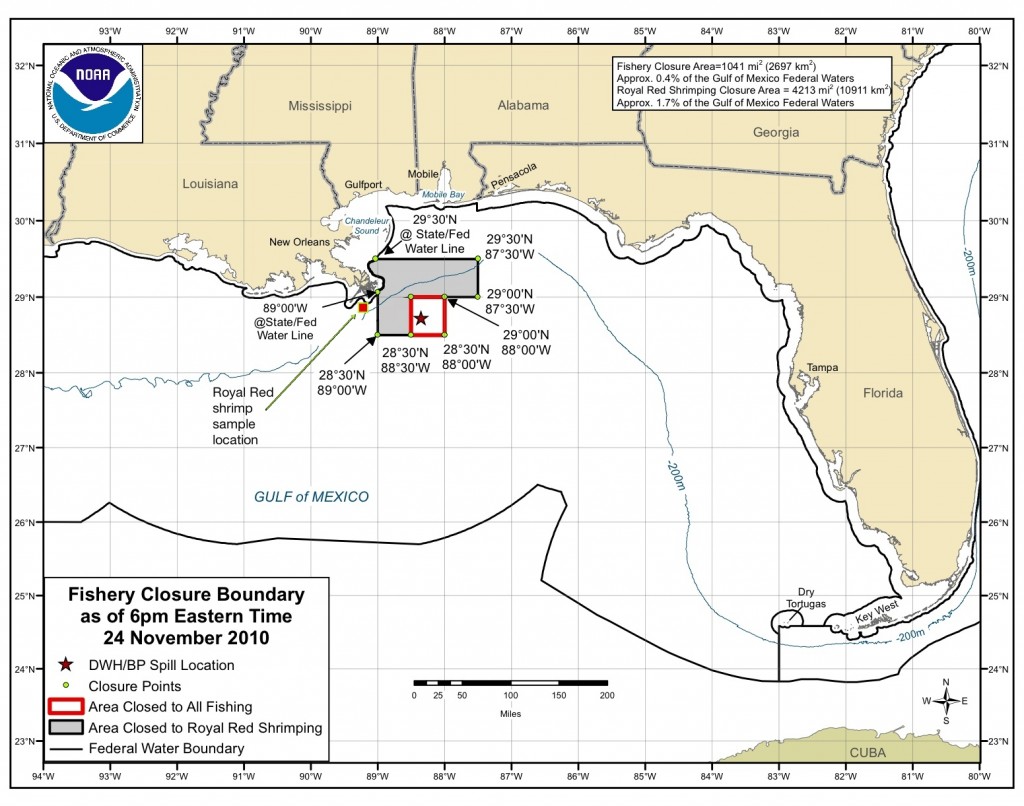
Before that happens, we should all take a look at the new test results below before bellying up to the raw bar. Our research team got this royal red shrimp sample (see below) in October from a commercial boat fishing west of the Macondo well site in Gulf waters legally open to fishing.
Sample description: Royal Red Shrimp
Sampled on: October 2010 by a commercial fishing captain
Sample location: West of spill site (see map below)
Testing by: ALS Laboratory of Edmonton, Alberta, Canada
This shrimp sample was collected by a commercial fishing boat captain in legal open Gulf waters (see map below). The petroleum hydrocarbon chromatogram of the royal red shrimp was a strong match to petroleum hydrocarbons found in the sea water sample that was taken at the same time and place as the shrimp sample. The top chromatogram is for TPH in seawater, while the lower chromatogram is for the royal red shrimp. The shrimp had total petroleum hydrocarbons at 439 mg/Kg, (PPM), and 58 ug/Kg, (PPB), of naphthalene, a PAH. Additional shrimp samples from Pensacola, FL, had up to 6,520 mg/Kg, (PPM), petroleum hydrocarbons. Shrimp in commerce in Louisiana had up to 8,356 mg/Kg, (PPM), petroleum hydrocarbons, and 17 ug/Kg, (PPB), of PAHs.
These are UNACCEPTABLE levels of contamination for shrimp entering the human food chain.
See lab report here: Royal Red Shrimp Data
© Smith Stag, LLC 2010 – All Rights Reserved
Seafood-Testing Flaw: Assumption of How Much Seafood Gulf Residents Eat Is Way Too Low
Most critics of the government’s seafood-testing program have focused on the tests themselves, confronting issues like using whole shrimp or using de-veined and shelled shrimp. But a new study by a respected environmental group looked at one of the simpler flaws: The assumption of how much seafood a Gulf family eats is just way too low.
It’s like food companies that want to lower “per serving” calories by lowering the serving size – so a normal can of black beans becomes 3 1/2 servings to get the per-serving calories under 100. It’s one thing to game us in the grocery aisle, but entirely another to water down tests for toxic seafood.
Bob Marshall at the Times-Picayune is reporting that “… a survey of 547 coastal residents in the four Gulf states by the Natural Resources Defense Council found they had seafood consumption rates far higher than those being used by federal and state regulators to determine if contamination levels pose a risk to human health…those results may indicate a large population of coastal residents has been left at risk by the state and federal health standards, the NRDC said.”
One NRDC official was quoted as saying “…my assumption is there are thousands if not hundreds of thousands of people who are not protected by the FDA guidelines.”
This should be huge news, and it illustrates once again the incredible disconnect between the federal position on seafood and reality.
How do you trust a process when a NRDC spokesperson has this to say about the real world: “When we looked at those parameters back in April, we realized the portion size for shrimp was about four jumbo shrimp eaten four times a month… but when we asked our partners on the Gulf Coast what they thought, they hooted and laughed, because they knew four jumbo shrimp won’t make one po-boy.”
The problem is that this lack of common sense leads to federal “testing” that is really only a sniff test, and the fact is it remains to be seen if seafood coming out of the Gulf is, indeed, safe for human consumption. Meanwhile, my clients who are commercial fishermen are still not fishing, because they are afraid of the effects. This report is yet another indication that they are correct to take a cautious approach – which is more than you can say for a testing process that dramatically low-balls consumption rates.
Read the report here: http://www.nola.com/news/gulf-oil-spill/index.ssf/2010/12/federal_guidelines_for_gulf_se.html
© Smith Stag, LLC 2010 – All Rights Reserved
Hard to Deny: Even Pro-Business Media Outlets Reporting There’s Oil Blanketing Gulf Floor
Everyone knew that the use of unprecedented amounts of dispersants would be one of the ongoing issues of the BP oil spill. Did it really break up the oil, or just hide it? Growing evidence indicates that, once again, federal officials who took the rosier view of the dispersant issue were dead wrong. With headlines like “Feds: Oil dispersant worked better than thought” hitting the streets only two weeks ago, you can almost hear them back-pedaling now.
One of the more significant mainstream media reports is from the Wall Street Journal, if only because of the paper’s typically pro-business view. The WSJ cites federal officials and a University of South Florida team reporting: “…material appears in spots across several thousand square miles of seafloor, they said. In many of those spots, they said, worms and other marine life that crawl along the sediment appear dead, though many organisms that can swim appear healthy. How the death of organisms in the sediment might affect the broader Gulf ecology is something scientists are studying.”
According to researcher Samantha Joye, a University of Georgia oceanographer, the impact is severe. She said the worms that live on the sea floor have been “just decimated.”
It’s interesting that the WSJ positions the use of dispersants thus: “Under federal direction, about 1.8 million gallons of dispersants were sprayed on the spilled oil in an effort to break it up into tiny droplets that natural ocean microbes could eat up. At the time, officials said the dispersants shouldn’t cause oil from the spill to sink to the seafloor. However, more recently, a federal report said dispersants may have helped some spilled oil sink to the sediment.”
I would question that “federal direction.” In reality, the federal government turned effective control over to BP, first asking the company to use the dispersant as little as possible and then rubber-stamping every type of use. Obviously, those who would argue that the company wanted to sink and hide the oil are supported by the new findings. The next question will be how tough the government gets with making sure that BP funds long-term studies to determine eventual damages.
And since BP is obligated to restore the natural resources, how exactly is the oil giant going to to remove this material from the environment, a mile beneath the surface? If anyone has an idea, please let me know.
The WSJ story is here: http://online.wsj.com/article/SB10001424052748704447604576007761183035214.html?mod=WSJ_hp_MIDDLENexttoWhatsNewsThird
© Smith Stag, LLC 2010 – All Rights Reserved
Cold, Hard Holiday Season for Spill Victims: Ken Feinberg’s Fund Denies 100,000 Claims in 10 Days as Processing Deadline Looms
After heavy political pressure ushered in a brief period of quicker, fairer claims payouts, it seems the Gulf Coast Claims Facility is back to business as usual. The Press-Register reports that in the last 10 days, Ken Feinberg’s $20 billion fund has denied more than 100,000 emergency claims as the Dec. 15 deadline approaches to process all 455,000 existing claims.
The sheer volume of recent denials is enough to raise eyebrows, but the seemingly hasty rate in dismissing them is downright alarming. As of the Thanksgiving holiday, a total of 67,000 had been rejected. In the relatively short period of time since Nov. 25, more than 100,000 additional claims have been turned down.
It’s disturbing that we’re seeing this kind of rush to judgment when people’s lives hang in the balance, particularly since it seems to be driven by the arrival of the artificially set processing deadline of Dec. 15.
The Claims Facility continues to reject claims based on what it calls “insufficient documentation.” But we’ve heard countless complaints from victims saying they’ve repeatedly provided the documentation the Facility requested but still await payment or have been denied. There have been countless complaints from victims saying they can’t get any answers out of the Facility regarding status of claims or reasons for claims being denied. We’ve heard countless requests, some more emphatic than others, for increased transparency – even from lofty places like the Department of Justice. Adding insult to injury, the stress of the process has triggered what amounts to a mental-health crisis in the Gulf.
Whatever the reason – valid or not – for this enormous surge in denials, tens of thousands of Gulf residents and businesses have claimed damages from the spill but will receive nothing from BP’s $20 billion compensation fund. On its face, that should bother anybody who cares about fairness and hard-working Americans, like fishermen and shrimpers and charter boat captains and a host of others.
We should remember, particularly during the holiday season, that these claims don’t just amount to numbers but rather represent real people and real families and real businesses, some of which will never fully recover from this disaster.
The next phase of this process will take place after the Dec. 15 deadline when the Claims Facility will begin working on final claims. Stay tuned…
Read the Press-Register report here: http://blog.al.com/live/2010/12/more_than_100000_emergency_oil.html
© Smith Stag, LLC 2010 – All Rights Reserved