RSS Feed for Politics Politics
Watering Down Seafood Safety
First it was the “sniff test” that had people wondering if the government knew what it was doing regarding testing Gulf seafood – now it’s consumption levels. The Press-Register newspaper in Mobile, which has been among the most skeptical news outlets in the context of the spill, is reporting: “…a coalition of environmental groups accuses the U.S Food and Drug Administration of failing to accurately estimate how much seafood coastal residents eat when setting safe levels for oil-related contaminants in fish, shrimp and crabs.”
We’ve brought this up before as an example of how the FDA can game the system. You want to control the outcome of an experiment? Then control the factors going into the equation.
Questions about seafood testing are nothing new (well, not here anyway), but I should note that they are going mainstream just as the “Mission Accomplished” crowd is preparing to spend tens of millions of dollars assuring people that Gulf seafood is safe. Who are you going to believe, a slick ad or the Natural Resources Defense Council and other groups issuing warnings?
The Press-Register has become a champion among those worried about seafood safety and has previously reported that FDA standards set after the BP spill allow higher levels of oil contaminants to be present in seafood than has been allowed after other major spills.
It’s also reported that, based on an FDA assumption, people eat FOUR times more fish than other types of seafood – and the agency standards allow shrimp, crabs and oysters destined for public consumption to be FOUR times more contaminated than fish. As mentioned, many experts believe the FDA assumption about how much seafood Gulf residents consume is far too low.
Those reports are shocking and should prompt swift government action. But this is the same Obama Administration that went along with low-ball spill estimates, put spin on NOAA reports and even had to effectively apologize to scientists after spinning their results. To admit that it’s now low-balling seafood contamination, might finally be the “tipping point” to really show that the BP spill is this Administration’s Katrina moment.
Read the Press-Register report here: http://blog.al.com/live/2010/12/fda_not_considering_gulf_seafo.html
© Smith Stag, LLC 2010 – All Rights Reserved
Oil-spill cleanup continues
HOUMA — Oil cleanup efforts are wrapping up in Terrebonne, as crews begin the exhaustive process of checking and double-checking cleanup work. But in Lafourche, heavy work is under way as crews dig deep into the beach to unearth sunken oil.
NEW TEST RESULTS: Royal Red Shrimp Collected by Commercial Fisherman in Open Gulf Waters Contaminated with Dangerous Levels of Petroleum Hydrocarbons
We’ve noted them individually but let’s connect some dots, because three huge news items are making the rounds that support claims that BP’s massive dispersant use hid much of its spill by sinking the oil to the sea floor.
Here’s how a few big relevant stories broke recently (then we’ll get to our troubling new test results):
- Shrimp boat pulls up a large load of tar balls while fishing for royal red shrimp in legal open Gulf waters in late November (see article here: http://news.yahoo.com/s/ap/20101125/ap_on_bi_ge/us_gulf_oil_spill_gulf_closure);
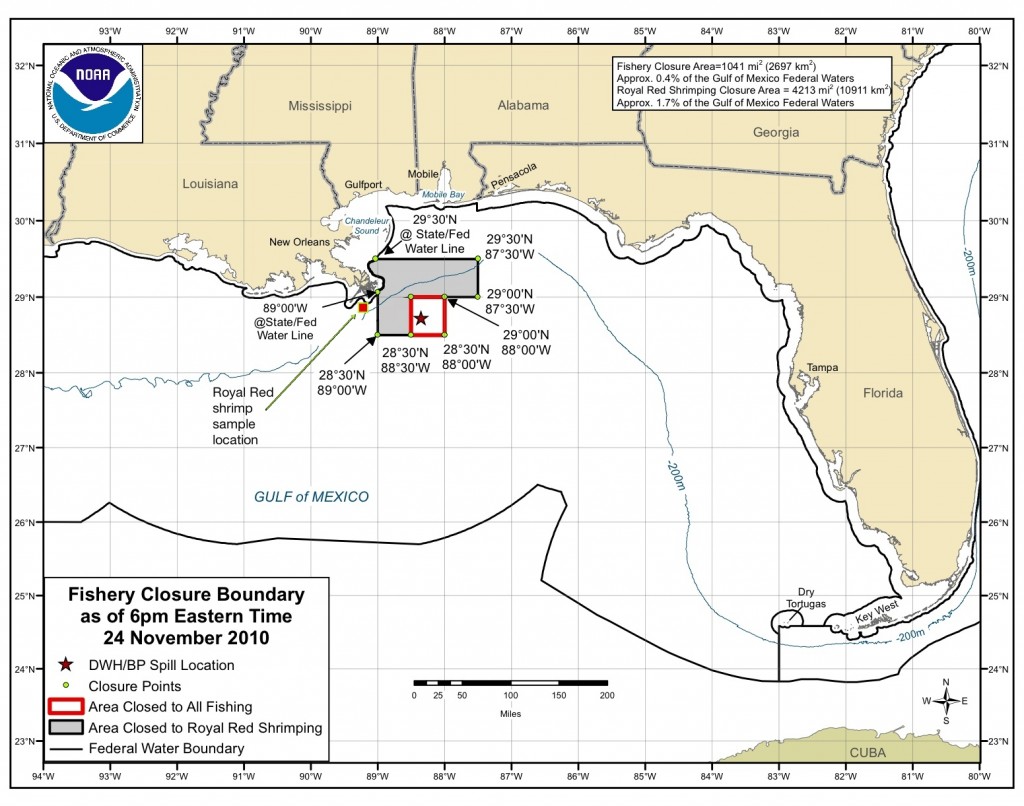
- NOAA re-closes 4,000 square miles to royal red shrimp fishing west and north of the Macondo well site, representing the first major NOAA backtracking on its relentless “what oil?” and “the seafood is safe” messages; and then
- Independent scientists aboard Navy sub, Alvin, find evidence that dispersant use has caused BP’s oil to settle to the ocean floor, killing bottom-dwelling sea organisms en masse (see article here: http://online.wsj.com/article/SB10001424052748704447604576007761183035214.html).
We should note that royal red shrimp are caught in deep water by dragging nets along the ocean floor.
A recent Times-Picayune report quoted NOAA’s Roy Crabtree, the assistant administrator for the federal Fisheries Services southeast region: “We are taking this situation seriously. This fishery is the only trawl fishery that operates at the deep depths where the tar balls were found and we have not received reports of any other gear or fishery interactions with tar balls.”
The closure area was re-opened to all fishing on Nov. 15. And remember those smell tests? Government officials used the infamous “sniff” test on shrimp, reportedly including royal reds, and the seafood passed the tests. As we’ve noted before, not everybody thinks those tests are worth much.
So, clearly, a lot of the oil sank to the bottom of the Gulf. Thousands of square miles are in question and literally tons of seafood. So much for the official declaration that “the vast majority of the oil is gone” and that Gulf seafood is safe for human consumption. Remember, earlier this week Navy Secretary Ray Mabus pressed all the military services to consume as much seafood as possible.
Before that happens, we should all take a look at the new test results below before bellying up to the raw bar. Our research team got this royal red shrimp sample (see below) in October from a commercial boat fishing west of the Macondo well site in Gulf waters legally open to fishing.
Sample description: Royal Red Shrimp
Sampled on: October 2010 by a commercial fishing captain
Sample location: West of spill site (see map below)
Testing by: ALS Laboratory of Edmonton, Alberta, Canada
This shrimp sample was collected by a commercial fishing boat captain in legal open Gulf waters (see map below). The petroleum hydrocarbon chromatogram of the royal red shrimp was a strong match to petroleum hydrocarbons found in the sea water sample that was taken at the same time and place as the shrimp sample. The top chromatogram is for TPH in seawater, while the lower chromatogram is for the royal red shrimp. The shrimp had total petroleum hydrocarbons at 439 mg/Kg, (PPM), and 58 ug/Kg, (PPB), of naphthalene, a PAH. Additional shrimp samples from Pensacola, FL, had up to 6,520 mg/Kg, (PPM), petroleum hydrocarbons. Shrimp in commerce in Louisiana had up to 8,356 mg/Kg, (PPM), petroleum hydrocarbons, and 17 ug/Kg, (PPB), of PAHs.
These are UNACCEPTABLE levels of contamination for shrimp entering the human food chain.
See lab report here: Royal Red Shrimp Data
© Smith Stag, LLC 2010 – All Rights Reserved
Seafood-Testing Flaw: Assumption of How Much Seafood Gulf Residents Eat Is Way Too Low
Most critics of the government’s seafood-testing program have focused on the tests themselves, confronting issues like using whole shrimp or using de-veined and shelled shrimp. But a new study by a respected environmental group looked at one of the simpler flaws: The assumption of how much seafood a Gulf family eats is just way too low.
It’s like food companies that want to lower “per serving” calories by lowering the serving size – so a normal can of black beans becomes 3 1/2 servings to get the per-serving calories under 100. It’s one thing to game us in the grocery aisle, but entirely another to water down tests for toxic seafood.
Bob Marshall at the Times-Picayune is reporting that “… a survey of 547 coastal residents in the four Gulf states by the Natural Resources Defense Council found they had seafood consumption rates far higher than those being used by federal and state regulators to determine if contamination levels pose a risk to human health…those results may indicate a large population of coastal residents has been left at risk by the state and federal health standards, the NRDC said.”
One NRDC official was quoted as saying “…my assumption is there are thousands if not hundreds of thousands of people who are not protected by the FDA guidelines.”
This should be huge news, and it illustrates once again the incredible disconnect between the federal position on seafood and reality.
How do you trust a process when a NRDC spokesperson has this to say about the real world: “When we looked at those parameters back in April, we realized the portion size for shrimp was about four jumbo shrimp eaten four times a month… but when we asked our partners on the Gulf Coast what they thought, they hooted and laughed, because they knew four jumbo shrimp won’t make one po-boy.”
The problem is that this lack of common sense leads to federal “testing” that is really only a sniff test, and the fact is it remains to be seen if seafood coming out of the Gulf is, indeed, safe for human consumption. Meanwhile, my clients who are commercial fishermen are still not fishing, because they are afraid of the effects. This report is yet another indication that they are correct to take a cautious approach – which is more than you can say for a testing process that dramatically low-balls consumption rates.
Read the report here: http://www.nola.com/news/gulf-oil-spill/index.ssf/2010/12/federal_guidelines_for_gulf_se.html
© Smith Stag, LLC 2010 – All Rights Reserved
At least two barrier islands to be rebuilt with $100 million in BP money
Louisiana coastal restoration officials plan to use $100 million given to the state by BP to rebuild at least two barrier islands west of the mouth of the Mississippi River, in conjunction with money available from several federal coastal restoration programs.
Money to double drilling inspection staff included in spending bill OK’d by House
The House on Wednesday approved 212-206 a $1.2 trillion spending bill that Democrats say will double the number of federal oil and gas inspectors needed to improve federal oversight of offshore drilling after the BP oil spill disaster.
Deep Clean in Orange Beach almost Over (VIDEO)
ORANGE BEACH, Alabama – As work continues on one of the biggest tar mats discovered on Alabama’s beaches, word tonight the deep clean of the coast in Orange Beach maybe coming to a close.
“Hopefully they are going to be out of here before Christmas,” says orange Beach Mayor Tony Kennon.
Federal guidelines for Gulf seafood safety questioned
Louisiana residents have long bragged about their prodigious consumption of local seafood, but a survey by an environmental group suggests that government seafood testing programs in the wake of the Deepwater Horizon oil spill severely underestimated that rapacious appetite for fish – and may have underestimated residents’ risk as a result.
Oil spill result: Amberjack season still open
BATON ROUGE, La. (AP) — Because the Gulf of Mexico oil spill kept anglers from getting offshore this year, they’re unlikely to hit the limit set to let greater amberjack recover from overfishing, officials have decided.
BP defender Joe Barton won’t lead House energy panel
WASHINGTON — Rep. Joe Barton, R-Texas, who apologized to BP last summer during the Gulf oil spill and then backtracked under pressure from GOP leaders, has failed in his effort to be named the chairman of the House Energy and Commerce Committee in the 112th Congress.
BP vice president: Effort to shut down oil well was 49 minutes too late
HOUSTON, Texas — Workers on the doomed Gulf of Mexico oil rig were distracted by multiple activities going on simultaneously and didn’t try to shut the well until 49 minutes after potentially explosive gas particles began flowing in, a BP vice president told a federal investigative panel Wednesday.
More than 100,000 emergency oil spill claims denied in 10 days
Ken Feinberg’s operation has denied more than 100,000 emergency spill claims in the past 10 days as it nears a Dec. 15 deadline to process all 455,000 such claims.
Halliburton technician was on smoke break as pressure built in BP’s Macondo well (PHOTOS)
A Halliburton Co. technician missed key signals that BP Plc’s doomed Macondo well was on the verge of blowing out because he was taking a smoking break, a federal investigative panel heard.
BP defender Joe Barton won’t lead House energy panel
WASHINGTON — Rep. Joe Barton, R-Texas, who apologized to BP last summer during the Gulf oil spill and then backtracked under pressure from GOP leaders, has failed in his effort to be named the chairman of the House Energy and Commerce Committee in the 112th Congress.