Posts for May, 2010
Fight Begins Over Venue for Deepwater Horizon Litigation
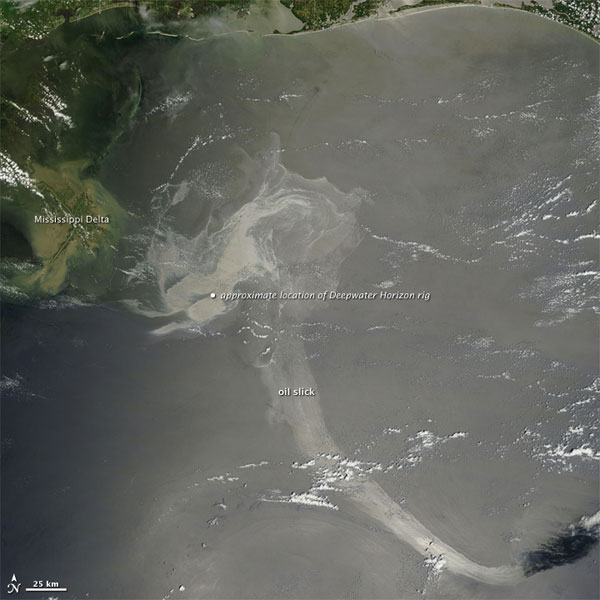 NEW ORLEANS (CN) – With more oil gushing into the Gulf of Mexico every week than spilled from the ExxonValdez, according to new estimates, lawyers across the Gulf Coast are gearing up for what may be the biggest environmental and maritime litigation the nation has ever seen. BP wants all the cases consolidated and heard in Houston – a suggestion that local attorneys call unconscionable.
And news came Monday that the oil may already be in the Loop Current, which would take it around Florida into the Atlantic Ocean, and, possibly, up the Eastern Seaboard.
Condo owner sues over oil spill
PANAMA CITY BEACH — A local beach family are the first in Bay County to sue the corporations behind the Deepwater Horizon oil spill for current and future damages caused by the leak.
The Griffitts family, the owner of Sugar Sands Inn and Suites, and their company, Griffitts Investments Limited Partnership, are suing BP, Anadarko Petroleum Corporation, Cameron International Corporation and Halliburton Energy Services Inc. in federal court in New Orleans for compensatory, incidental, consequential, statutory and punitive damages caused to his business by the explosion and resulting spill.
BP Gulf Oil Spill 2010: Oil Leak Plugging, Dome Idea Crashes, Now Plug It With Garbage
BP Gulf Oil Spill 2010, BP oil leak: As British Petroleum went ahead with their latest plan to plug the oil leak in the gulf by placing a huge metal dome over it, and they did place it. But……… instead to funnel out the oil to the ship tankers on the surface, the four storied metal box got clogged with ice like crystals, which was a mixture of oil and natural gas.
With an estimation that more than 2 million gallons of oil has already gushed into the sea, the next idea of shutting the leak was putting on a smaller dome, because a smaller dome will contain less water and will be less vulnerable.
Conflict of Interest Worries Raised in Spill Tests
Local environmental officials throughout the Gulf Coast are feverishly collecting water, sediment and marine animal tissue samples that will be used in the coming months to help track pollution levels resulting from the Deepwater Horizon oil spill.
Hundreds of millions of dollars are at stake, since those readings will be used by the federal government and courts to establish liability claims against BP. But the laboratory that officials have chosen to process virtually all of the samples is part of an oil and gas services company in Texas that counts oil firms, including BP, among its biggest clients.
Gulf County, Fla. Retains Krupnick Campbell Malone Buser Slama Hancock Liberman & McKee to represent them during BP Oil Spill
Gulf County, Florida became the first governmental entity to retain Krupnick Campbell Malone Buser Slama Hancock Liberman & McKee, part of a team of independent lawyers, to represent its interests in the BP DEEPWATER HORIZON catastrophe, announced Attorney Stuart H. Smith and Florida Attorney Bob McKee.
The independent team of lawyers is already representing commercial fisherman and environmental activists in the Gulf region.
70,000 Barrels a Day
Experts are now saying the spill is leaking 70,000 barrels a day. That’s more than 10 times the initial estimates. Ten times. I hate to say I told you so, but…
The new estimate is equivalent to an Exxon Valdez-type accident every four days.
BP has tried to mask the true extent of the damage of the disaster by injecting dispersants directly at the gusher site –– even though laboratory and field experience show that these compounds are poisonous at low concentrations to fish and crustaceans including shrimp, crabs and lobsters, and oysters. The dispersants have helped to keep the oil below the surface in a huge underwater plume that cannot be easily detected by helicopters flying overhead or even by satellite.
BP must be required to monitor and gather the evidence of the presence of its oil in that water column so that it can be tracked throughout the marine geography, from Texas to South Florida. Prime fisheries start their lives in the very area where the oil and dispersants have been focused. Evidence shows that the larvae of Florida lobsters move into these open waters where they are most susceptible to damage from the oil and dispersants. Game fish breed in the areas that center on this disaster zone.
This is going to be a huge blow to the Gulf Coast economy that may take generations to fully recover from.
© Smith Stag, LLC 2010 – All Rights Reserved
EXPERTS DETERMINE TRUE EXTENT OF OIL SPILL: 70,000 BARRELS A DAY Team of independent lawyers and Louisiana Environmental Action Network DEMAND IMMEDIATE AND EXTENSIVE TESTING OF PLUME
Federal decision to ‘ok’ BP dispersants damaging to wildlife and Gulf Coast culture
NEW ORLEANS, La. (May 15, 2010) — As predicted by Attorney Stuart Smith, of Smith Stag, LLC, on April 30, 2010, experts have determined that nearly 70,0000 barrels of crude oil are gushing out every day in the wake of the Deepwater Horizon disaster. This information comes after the release of video by BP, which was first demanded by Mr. Smith on behalf of the Louisiana Environmental Action Network and United Commercial Fisherman’s Association.
Mr. Smith had the following statement:
United Commercial Fisherman’s Association Petitions Federal Court to Appoint Overseer of BP Payments Process
Fishermen continue to site abuses of payment system, especially against fishermen who have hired attorneys
Citing on-going hi-jinks in payments to fisherman distressed by the DEEPWATER HORIZON catastrophe, George Barisich, President of the United Commercial Fisherman’s Association, is petitioning the U.S. District Court, Eastern District of Louisiana, to appoint a “Special Master” to provide oversight and guidance in the claims processing program initiated by BP.
Foot-in-Mouth Disease
It’s interesting that BP CEO Tony Hayward has told the British press that his job is on the line. See this link, http://www.guardian.co.uk/business/2010/may/13/bp-boss-admits-mistakes-gulf-oil-spill…
In an interview with the Guardian at BP’s crisis centre in Houston, Hayward also insisted that the leaked oil and the estimated 400,000 gallons of dispersant which BP has pumped into the sea to try to disperse the slick were relatively “tiny” amounts. “The Gulf of Mexico is a very big ocean. The amount of volume of oil and dispersant we are putting into it is tiny in relation to the total water volume,” Hayward said.
It’s tough to decide exactly where to begin when discussing all the things that are wrong with Hayward’s comments. I disagree, big time, with Mr. Hayward’s assessment of the potential human health risks posed by the spill. With a spill of this size, the threat to human health will always be a serious concern. Mr. Hayward and BP have many questions to answer. Maybe, if he can’t deal with the human health risks, he can answer questions about what exactly is on board the Damon Bankston, a boat which has been docked in Port Fourchon containing mud from the Deepwater Horizon site. Supposedly, the FBI and other federal agencies are holding the boat.
Also, Louisiana sources tell us the latest capping effort has been postponed until the weekend. What’s going on, BP?
© Smith Stag, LLC 2010 – All Rights Reserved
BP Executive says Gulf of Mexico is big enough to handle spill…and then admits his job is on the line. However, he and his company are still avoiding critical questions
Latest ‘cap’ effort postponed? Secret mud-filled barge in harbor?
Statement from Attorney Stuart Smith:
“It is interesting that Tony Hayward of BP has told the British press that his job is on the line. See this link,
http://www.guardian.co.uk/business/2010/may/13/bp-boss-admits-mistakes-gulf-oil-spill, where he also says
In an interview with the Guardian at BP’s crisis centre in Houston, Hayward also insisted that the leaked oil and the estimated 400,000 gallons of dispersant which BP has pumped into the sea to try to disperse the slick were relatively “tiny” amounts. “The Gulf of Mexico is a very big ocean. The amount of volume of oil and dispersant we are putting into it is tiny in relation to the total water volume,” he said.”
“Our statements earlier this week after the congressional hearings (www.gulfoildisasterrecovery.com) about human health risks clearly disagree with his assessment. Mr. Hayward and BP have lots of questions to answer. Maybe, if he can’t deal with the human health risks, he can answer questions about what exactly is on board the Damon Bankston, a boat which has been docked in Port Fourchon with mud from the DEEPWATER HORIZON site. Supposedly, the FBI and other federal agencies are holding the boat.
Also, Louisiana sources tell us the latest capping effort has been postponed until the weekend. What’s going on, BP?”
A related blog
http://www.insurancedisputelawyerblog.com/2010/05/attorney_jeffrey_berniard_tour.html
Fishermen win another concession from BP
The U.S. District Court for the Eastern District of Louisiana “stipulation” binds British Petroleum to honor commercial fishermen’s legal claims against BP even if fishermen received a “subsistence” payment
Consent Agreement signed on May 11 by all parties is attached.
Attorney James Garner, on behalf of United Fisherman’s Association and its President George Barisich, today issued this statement:
EPA Air Testing Data Still Shows High Levels of Airborne Toxins From BP’s DEEPWATER HORIZON Disaster
Statement by Toxicologist Dr. William Sawyer for team of independent lawyers representing LEAN and United Commercial Fisherman’s Association:
“Yesterday, we confirmed a recent evaluation done by the Louisiana Environmental Action Network (LEAN) of the Environmental Protection Agency’s results of air content and quality testing, showing that the level of some airborne toxins is greater than 100 times the quantity considered safe to humans and could cause physical reactions.
Dispersants have potential to cause more harm than good
The chemical dispersants being used to break up the oil leaking into the gulf following the explosion of British Petroleum’s Deepwater Horizon offshore oil rig have the potential to cause just as much, if not more, harm to the environment and the humans coming into contact with it than the oil possibly would if left untreated.
That is the warning of toxicology experts, led by Dr. Wiliiam Sawyer, addressing a team of independent lawyers working to protect the rights and interests of environmental groups and persons affected by the Deepwater Horizon disaster. The team of independent lawyers represents the United Commercial Fisherman’s Association and the Louisiana Environmental Action Network (LEAN), among others.
Independent Team of Lawyers to fight Transocean’s move to limit their liability in the DEEPWATER HORIZON catastrophe
An independent team of lawyers, representing clients such as the United Commercial Fisherman’s Association and Louisiana Environmental Action Network, said they will fight a move by Transocean (and its Swiss parent company Triton) to limit their liability for the ecological, economic and human catastrophe unfolding in the U.S. Gulf Coast, said Stuart Smith, of Smith Stag, LLC.
Transocean has filed a lawsuit in Houston, Texas under federal admiralty law seeking to limit their liability in the catastrophe to only $26.7 million, and to compel all injured parties to file claims to that money by November 15, 2010
Attorney Smith said Transocean’s assertions that it is not liable for the entire scope of the harm caused by the rig’s failure and the resulting oil spill will be challenged.
Regardless of whether this process in Houston is allowed to move forward, Mr. Smith recommends that anyone believing they have suffered loss and injury due to the DEEPWATER HORIZON catastrophe and has a claim against Transocean should prepare to assert their claim, keep documentation of their loss, and consider whether they should hire an attorney.
“Obviously, an accelerated claims process is being considered. All injured parties must take action to protect themselves,” said Mr. Smith.
Air quality testing in Venice, Louisiana near the DEEPWATER HORIZON oil spill shows level of toxins greater than 100x the amount safe to humans
Continued degradation of air quality in coastal communities very likely
Stuart Smith, of Smith Stag, LLC, representing the Louisiana Environmental Action Network and United Commercial Fisherman’s Association today issued this statement:
“On April 30, on behalf of citizens living and working in Louisiana near the British Petroleum catastrophe, I urged all officials working to resolve this man-made problem to deal in facts and with transparency. At the time, we warned we were on the edge of the worst-case scenario.”